

The franchisees sell, the headquarters earns: where 7-Eleven’s 28% margin comes from
A 28% margin from a retailer that owns almost none of its stores
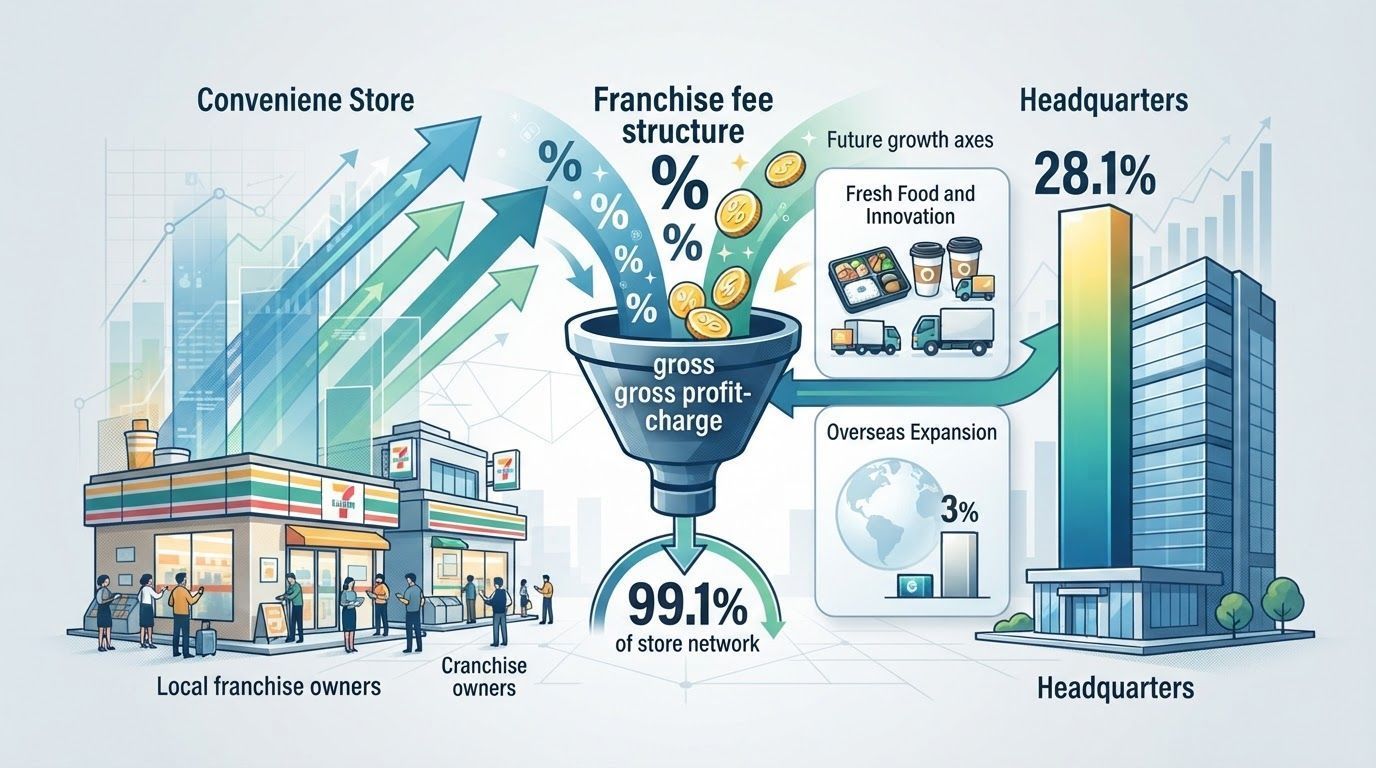
Start by separating numbers that are easy to conflate. In the year ended February 2024, Seven-Eleven Japan reported ¥894.6bn in operating revenue, ¥251.0bn in operating profit and a 28.1% operating margin. Chain-wide sales across all stores were about ¥5.3tn. The company directly operated just 193 of its 21,363 stores, or 0.9%; franchisees ran the other 21,170.
How does a retailer that owns almost none of its stores earn a 28% operating margin? The answer is not on the shelf. It is in how headquarters and franchisees divide the store’s gross profit. 1 2
First, separate whose sales these are 1 2
| Item | Amount or count | What it means |
|---|---|---|
| Headquarters operating revenue | ¥894.6bn | Revenue booked by headquarters, not store sales |
| Of which: franchisee income | ¥824.8bn (92.2%) | Franchise fees and management-support revenue |
| Of which: direct-store sales | ¥60.7bn (6.8%) | Merchandise sales at 193 directly operated stores |
| Operating profit | ¥251.0bn | 28.1% operating margin |
| Stores | 21,363 | 21,170 franchised (99.1%) |
| Chain-wide sales | About ¥5.3tn | Sales of all stores; a different measure from headquarters revenue |
The fee is charged on store gross profit, not sales
In Seven-Eleven Japan’s fiscal 2023 income statement, “income from franchisees” was ¥824.8bn out of ¥894.6bn in operating revenue—92.2%. Direct-store sales were only ¥60.7bn. Headquarters earns mainly by charging franchisees, not by selling goods to consumers. This is recurring income that arises as long as the store operates, not a one-off merchandise sale.
The contract calls the fee the “Seven-Eleven charge.” Under the published A-type contract, it equals 45% of store gross profit (sales minus the cost of goods); 43% for 24-hour stores. The C-type contract uses a sliding rate tied to gross profit. The common shorthand that “headquarters takes about half of store gross profit” is an industry approximation; the actual rate varies by chain, contract type and discount scheme. 1 3 4
What matters is the base: the fee is charged on store gross profit—sales minus the cost of goods—not on store sales. If a store sells more and earns more gross profit, headquarters earns more, but it does not directly carry purchasing, inventory or waste. Under the A-type contract, the cost of unsold and defective goods falls mainly on the franchisee; headquarters covers 15% of that cost. Headquarters does cover 80% of utilities. 3
What does the franchisee actually carry? 3 4 Under the A-type contract, the owner provides land and the building and signs a 15-year agreement. The owner bears labor, inventory and most waste costs. Headquarters covers 80% of utilities and 15% of defective-goods cost, and provides a minimum-income guarantee (¥22m a year for a 24-hour store, ¥19m otherwise). The C-type contract has headquarters provide land and building, a sliding charge and a minimum guarantee of ¥20m for a 24-hour store, ¥17m otherwise. The guarantee covers the owner’s total income, not profit: labor and waste still come out of it. Even stores in similar locations and under the same contract differ in how they stock short-shelf-life items such as bento and fried food; the owner’s ordering and operating choices ultimately show up in store gross profit.
How one store’s gross profit is divided 3
Customers pay, creating store sales. Subtract the cost of goods and you get store gross profit. Headquarters takes its contractual charge (45% for A-type, 43% for 24-hour stores); the rest goes to the owner, who pays labor, rent, utilities and waste. Headquarters uses the charge to fund product development, logistics and store support.
flowchart LR
    sales["Store sales"] --> gross["Store gross profit"]
    gross --> hq["HQ charge about 45%"]
    gross --> owner["Owner keeps about 55%"]
    owner --> costs["Labor rent utilities waste"]
    hq --> support["Product development logistics support"]
Domestic stores plateau, so growth moves to fresh food and delivery
The model assumes that both store count and gross profit per store keep growing. In Japan, the first assumption has weakened. Based on Japan Franchise Association data, the major convenience chains operated 55,931 stores at the end of fiscal 2021, 55,852 at the end of fiscal 2022 and 55,657 at the end of fiscal 2023—a cumulative decline of 274 over three years. The total recovered to 55,849 at the end of fiscal 2024, still below the 2021 level. Population decline and site competition have made new-store expansion a weaker source of growth. 2
All three chains are shifting from “more stores” to “more per store.” The three examples below cover delivery, fresh food and sales-floor renovation; they differ in approach but all aim to add gross profit at existing stores. 11 10 9
- Lawson: turn delivery into an additional store channel. It introduced Uber Eats in 2019, the first among convenience chains, and kept adding participating stores. In 2024 it expanded delivery assortment from about 700 items to more than 3,000.
- Seven-Eleven: roll out 7NOW delivery nationwide while installing dedicated preparation equipment and bringing “made-fresh” production into stores. Seven Cafe smoothies went to full rollout in March 2023; freshly baked pizza was sold at about 200 stores in the Tokyo area, Kyushu and Hokkaido as of August 2024; freshly fried curry bread has become a traffic driver.
- FamilyMart: stop relying only on new openings. It plans to expand the sales floor at about 5,000 stores by attaching container-style units and cutting eat-in space. It aims to renovate about 1,000 stores by February 2026 and lift daily sales per store by roughly 10%.
Can fresh food and delivery reproduce headquarters’ high margin? Not automatically. Fresh food can raise gross profit per store, and delivery can widen the catchment, but both add equipment, labor and fulfilment costs—costs that sit mainly at store level. For headquarters, the direct effect is to raise franchisee gross profit and therefore the gross-profit-linked charge. That is a way to make stores bigger, not a new high-margin revenue stream. Judge it by whether the incremental gross profit covers equipment depreciation and labor, not by the rise in headquarters revenue alone.
Beyond ¥10tn: overseas brings scale, and thinner margins
As domestic store growth stalled, the scale story moved overseas. In the year ended February 2023, Seven & i Holdings reported ¥11.81tn in consolidated revenue, becoming the first Japanese retailer to exceed ¥10tn. Revenue was ¥11.47tn in the year ended February 2024. The overseas convenience-store segment generated ¥8.52tn, or 74.2% of consolidated revenue, in the year ended February 2024. 5 8 6
Why was the Speedway deal decisive? 6 7 In May 2021, Seven & i acquired the US Speedway business for more than ¥2tn. Speedway’s stores and fuel retailing pushed overseas convenience-store revenue far above domestic revenue. By the year ended February 2024, cumulative integration synergies had reached $976.5m, beating the original $800m target. The deal also added debt and capital spending, and exposed the group to gasoline prices, exchange rates and the US consumer cycle.
But revenue size is not profit quality. In the year ended February 2024, the domestic convenience-store segment earned an operating margin of about 27.2% (¥250.5bn on ¥921.7bn), while the overseas segment earned about 3.5% (¥301.6bn on ¥8.52tn). Overseas revenue was 9.2 times domestic revenue, but overseas operating profit was only 1.2 times domestic profit. The domestic model is light: it collects a charge on franchisee gross profit. The overseas model is heavy: it includes company-operated stores and fuel retailing. Adding the two produces the scale impression that more than 70% of revenue is overseas, while hiding that the group now runs two different profit models. 6
Expansion continues. In February 2023, 7-Eleven International decided to invest in the Vietnam business. In November 2023 it announced the acquisition of Australia’s Convenience Group Holdings, completed on April 1, 2024. It also entered Israel and Laos in 2023, bringing 7-Eleven to 20 countries and regions. The company aims to operate in 30 countries and regions, including Japan and North America, by fiscal 2030, and has described a pace of about two new countries a year. 6 7
Conclusion: the high margin is a design choice, not a retail accident
Back to the opening question. The 28% margin is the product of a franchise design that separates selling from charging. Franchisees carry location, labor, inventory and most waste risk; headquarters supplies products, logistics, systems and brand, and takes a percentage of store gross profit. That lets headquarters earn a high margin with very few company-owned stores, but it ties headquarters’ growth to gross profit per store. Once the domestic store count stalls, headquarters can either raise store gross profit (fresh food, delivery, bigger sales floors) or buy scale overseas. The first is slow; the second is thin-margin. Neither is a simple copy of the original high-margin machine.
- First ask whose sales you are looking at. Chain-wide sales, headquarters revenue and franchisee income are different measures, and their margins are not directly comparable.
- Then ask what the fee is charged on. A sales-based fee and a gross-profit-based fee distribute risk between headquarters and stores very differently.
- Finally, ask which business earns the profit. Domestic franchising and overseas company-operated and fuel retailing run at different margins, and the consolidated total hides the gap.
Sources
- セブン-イレブン・ジャパン 第51期 損益計算書(2024年2月期)
- セブン&アイ・ホールディングス 国内コンビニエンスストア事業(事業データ)
- セブン-イレブン・ジャパン Aタイプの加盟条件
- セブン-イレブン・ジャパン Cタイプの加盟条件
- セブン&アイ・ホールディングス 業績ハイライト
- セブン&アイ・ホールディングス 2024年2月期 有価証券報告書
- 東洋経済オンライン「セブン&アイ、ついに動き出した海外戦略の成否」
- 日本経済新聞「セブン&アイ、小売業初の売上高10兆円超え 23年2月期」
- 日本経済新聞「ファミマ5000店増床へ コンテナ外付け、出店依存を脱却」
- MD NEXT「店内調理に慎重姿勢を方向転換か?セブン−イレブンの『出来たて』商品開発」
- ローソン「ローソンデリバリー powered by menu」順次スタート