

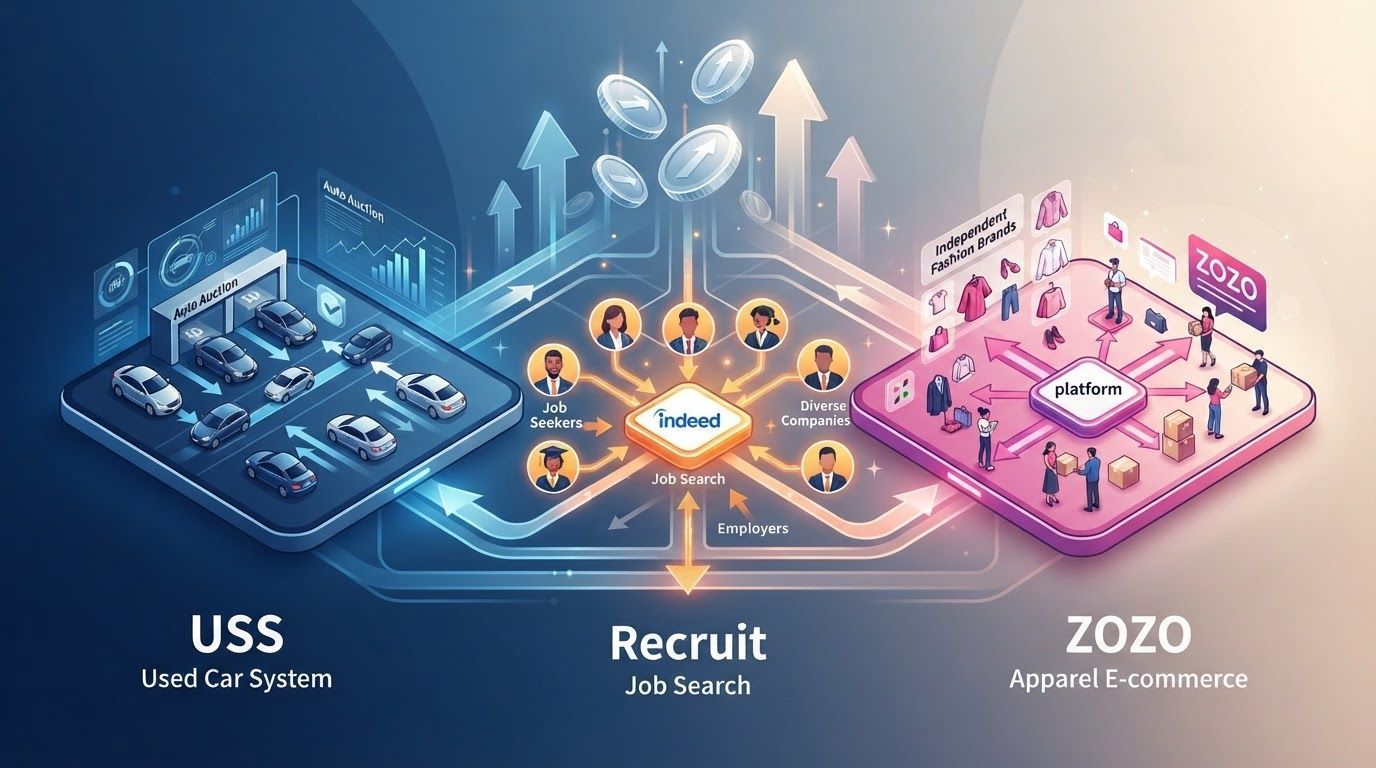
No Inventory, Most of the Profit: The Matching Model Behind Three Japanese Companies
In the used-car business, one company charges a little over 5,000 yen per vehicle listing, another 8,000-plus yen when a car sells, and 13,000-plus yen more when a buyer places the winning bid. Its operating margin sits around 50%. In the same industry, listed companies that buy and resell cars earn operating margins of just 3% to 4%.
The gap is not a matter of effort. It comes from where a company stands: one side brokers the transaction, the other owns the goods. This article looks at three cases—USS, the used-car auction platform; Recruit Holdings, owner of the job search engine Indeed; and ZOZO, operator of the apparel marketplace ZOZOTOWN—to see why the matching business is so profitable, and what conditions it depends on.
USS: Turning a Used-Car Auction Into a Toll Booth
USS's business breaks down into three fees. The seller—usually a car-buying company—pays a listing fee of 5,702 yen per vehicle to bring it to the auction. If the car sells, there is a transaction fee of about 8,830 yen. The buyer—usually a dealership—pays a winning-bid fee of 13,350 yen when the hammer falls. From the moment a car enters the venue to the moment it changes hands, the platform collects a fee at several points.
What makes this fee structure work is not a license. It is the infrastructure that brings both sides to the table. Founded in 1980, USS placed inspectors at each company and built a thorough inspection system to vouch for vehicle condition. It also moved early to set up remote bidding by satellite television and the internet, so members could bid without traveling to the venue. Inspection reduced the uncertainty of buying a car you cannot see; remote bidding widened the pool of buyers and, in turn, increased the number of vehicles listed. Over the past two decades, USS's market share grew from about 20% to 40%, making it the industry leader.
Scale then reshapes the cost structure. In fiscal 2023, the auction business accounted for nearly 80% of USS's sales, with a segment profit margin above 60%, while its other businesses sat at about 6%. The main costs of an auction platform are personnel and equipment depreciation. Revenue rises with the number of cars sold, but costs do not rise in proportion. In the same used-car industry, Nexstage, which focuses on buying and selling, has an operating margin of 3.4%, and IDOM, which runs Cariva, 3.8%. USS is not selling cars. It is selling the passage a car takes to change owners.
The Spread Business: From Wholesale to Retail
The position of USS's customers—used-car buyers—is the mirror image. They purchase cars from consumers and sell them at auction, earning the spread between the buying and selling price. This is a wholesale business: the car belongs to them, and so does the price risk. When competition for buying cars intensifies, the spread gets squeezed.
That is why more of these companies have shifted to retail in recent years, selling the cars they acquire directly to consumers. A retail sale earns gross profit on the vehicle itself and can be layered with warranties, financing, and other products and services, leaving more room for profit. IDOM, which runs Cariva, offers a clear comparison. In fiscal 2023, gross profit per car was 10,000 yen in wholesale and 410,000 yen in retail. Unit volumes were nearly identical, yet about 80% of gross profit came from retail. The company's retail volume has already overtaken wholesale and is still growing.
The comparison shows that profitability inside the used-car industry does not depend on whether a company is a middleman. It depends on whether the company buys the goods outright, whether it carries inventory and price risk, and whether it can add services on top of the product. USS collects a transaction fee; IDOM earns the spread on goods plus the value of services. Their cost structures and profit elasticity are entirely different.
Recruit: Turning Job Hunting Into a Keyword Auction
Recruit Holdings' matching business is broader. Recruit and Townwork in staffing, SUUMO in real estate, and Hot Pepper in restaurant and salon reservations are all platforms connecting demand with supply. The biggest contributor in recent years is Indeed, the U.S. job search engine acquired in 2012.
Indeed's mechanism is straightforward. A job seeker enters keywords and a preferred location. The results include job postings registered by employers as well as job pages automatically collected from across the internet, and the system displays the best matches. Employers can post jobs for free. Paid options increase how often a posting is shown, making it easier for job seekers to notice. The employer pays each time a job seeker clicks, and the cost per click is set by automatic bidding based on the employer's budget and other factors. In other words, Recruit has broken "being seen" into a series of individually priced actions.
Scale is the premise of this model. Indeed draws about 350 million monthly visitors worldwide and more than 22 million in Japan. The HR Technology segment, centered on Indeed, generated nearly 60% of Recruit Holdings' profit in the fiscal year ended March 2024. What supports it is AI technology and the data accumulated on both sides. The more data from job seekers and employers, the more accurate the matching and the simpler the hiring process. The company's stated goal is a world where a job search is completed with one click.
Pricing is also changing with the situation. In the United States, alongside pay-per-click, the company has introduced application-based charging, which bills only when a job seeker actually starts an application. In Japan, Indeed PLUS lets employers publish a posting once and have it appear on job sites beyond Indeed. The same matching capability can be priced per click, per application, or per distribution scope. The same kind of business is spreading into other areas. Skill-sharing services such as Crowdworks, Lancers, and Coconala began with low-priced tasks like writing and data entry and have expanded into higher-priced work that requires specialized skills.
ZOZO: A Fashion Department Store That Never Touches Inventory
ZOZO runs ZOZOTOWN, one of Japan's largest apparel marketplaces, and its operating margin in the latest fiscal year was about 30%. In a fiercely competitive apparel e-commerce market, that number stands out—for the same reason: the company stands in the matching position.
Nearly 80% of ZOZOTOWN's transaction value comes from consignment sales. Brands hand their products to ZOZO, which inspects, measures, photographs, and stocks them before listing them on ZOZOTOWN. When a user orders, ZOZO ships the item and collects payment, then charges the brand a consignment fee calculated as the selling price times a commission rate. Rates vary by brand and are generally said to run between 30% and 40%. That fee is recorded directly as ZOZO's sales.
The key is that ZOZO does not buy the goods. Products in the warehouse belong to the brands, so ZOZO carries no risk of unsold inventory. At the same time, ZOZOTOWN's ability to draw shoppers is what persuades brands to accept a high fee in exchange for reliable sales. The platform matches brands with consumers and charges for access to the channel, not for the spread on goods.
Beyond consignment, ZOZO also manufactures and sells its own-brand products and sells used goods—the secondary market. But the faster-growing business is advertising. ZOZO's ad business ties into the words users search for and shows relevant products from brands. It generated 1.4 billion yen in fiscal 2018 and grew to 9.7 billion yen in fiscal 2023. The real sales data accumulated through e-commerce makes this advertising work as "retail media," a field where Amazon and TikTok are also investing.
The Common Thread, and Its Limits
The three companies operate in completely different industries, and their fees have different names: USS charges listing, transaction, and winning-bid fees; Recruit charges per click and per application; ZOZO collects consignment commissions and advertising revenue. But the underlying structure is the same. They do not buy the goods. Revenue grows with transaction volume. The main costs are people and systems, and they grow more slowly than revenue. The more transactions, the lower the fixed cost per transaction, and the higher the margin.
The model has a clear precondition: the platform must attract both buyers and sellers. USS widened its buyer pool through inspection and remote bidding, Indeed improves match accuracy with data and AI, and ZOZO's drawing power persuades brands to accept its rates. Without that pull, the fees cannot be charged, and the platform loses its pricing power.
Conversely, once a platform buys the goods itself, it takes back price and inventory risk, and its margin returns to the level of a product business. IDOM's shift from wholesale to retail is not an escape from matching; it is a search for added value within the product business. And USS's car-buying customers are squeezed precisely because they carry the heaviest price risk in the chain.
The value of the matching business is not that it is "asset-light." It is that it turns "bringing buyer and seller together to close a deal" into infrastructure that can be billed per transaction. Only once that works does it make sense to argue about how high the fee should be.