

Three Ways to Sell Advertising: What Nippon TV, Kakaku.com, and Meta Are Really Selling
Three companies that seem to have nothing in common: a Japanese commercial broadcaster, a Japanese internet company that runs a restaurant-review site and a price-comparison site, and a Silicon Valley social platform. What they share is that roughly 80% of their revenue comes from advertising.
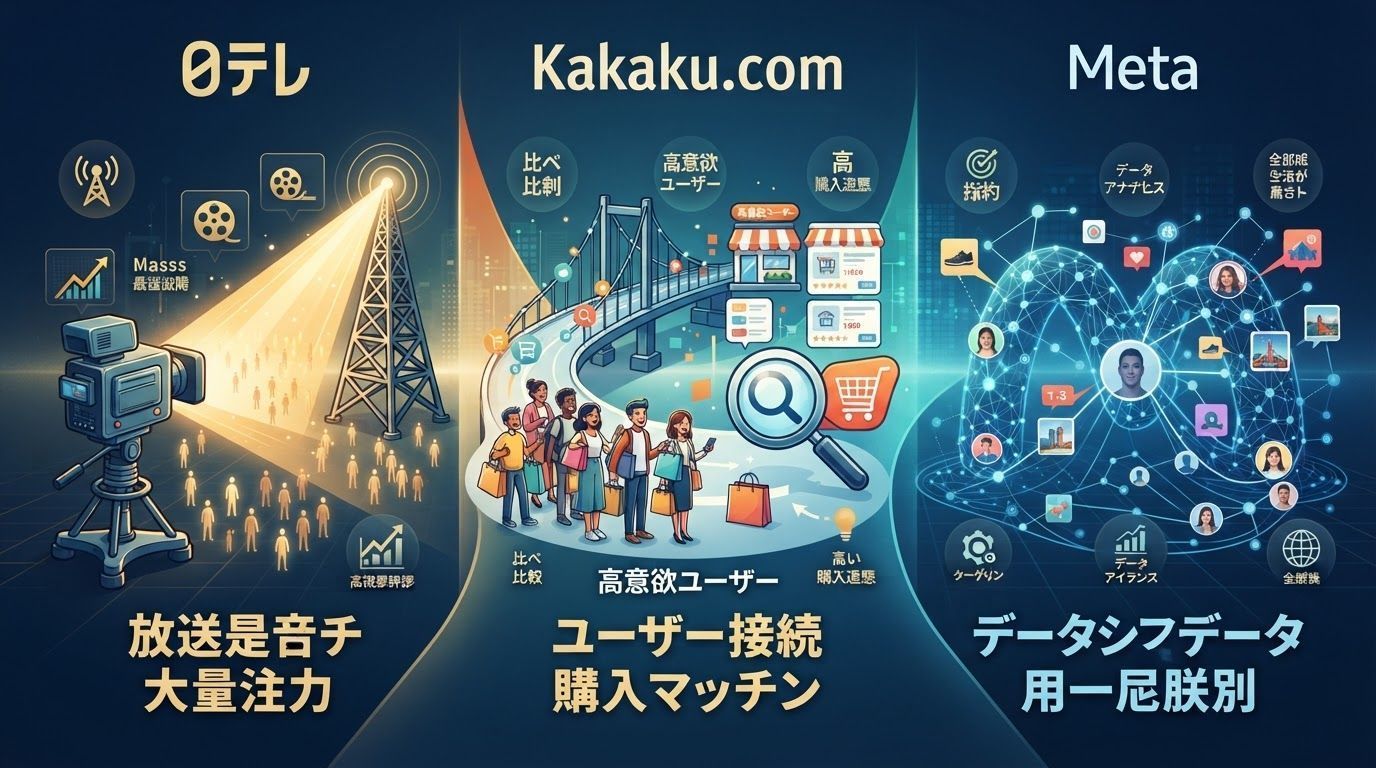
But "making money from ads" is not one business; it is several. Advertisers never pay for "advertising" as such. They pay for some scarce resource: time spent being watched, the moment just before a purchase decision, or the ability to pick out specific people. Nippon TV Holdings, Kakaku.com, and Meta represent these three ways of selling, and each carries its own costs.
1. Nippon TV: Selling "Time Being Watched"
The business model of Japanese commercial television (excluding NHK) takes a few sentences to explain: the broadcaster sells ad slots to sponsors, sponsors run commercials inside programs, and viewers get to watch for free. In Nippon TV Holdings' financials, about 80% of sales at the core television broadcasting business come from advertising. Advertising is the cash cow.
A commercial is not a single, undifferentiated unit of inventory. There are at least three types, with completely different rules.
The first is time advertising (タイム広告), or program sponsorship. A sponsor backs a specific program, and its commercials run in the slots within that program; the sponsor's name appears at the start and end as "program sponsor." The minimum unit is 30 seconds, and the standard commitment is six months. The appeal is that you can choose the program: want to reach young people, pick a show for young viewers; want to reach women, pick a women's program. The image of the program also rubs off on the company and its products.
The second is spot advertising (スポット広告), which has nothing to do with program content. It runs in fixed slots between programs, with a minimum unit of 15 seconds. It is more flexible than time advertising: the purchase period can be set freely, so a company can buy a short slot only for a product campaign.
The third is digital advertising. As catch-up and streaming services such as TVer spread, broadcasters have started selling ads around online program distribution. The scale is still small, but with sponsors drifting away from television and both time and spot revenue hard to grow, it is the only segment that is expanding.
Nippon TV's ad revenue breakdown makes the point: 226.1 billion yen in total, of which sponsor slots account for 114.1 billion, time advertising 105.1 billion, and digital advertising just 6.9 billion. In other words, the company still lives off traditional television slots; the new business is a rounding error.
And the price of a traditional TV slot is anchored to ratings. Advertisers are buying "how many people watch, in which time band," so the higher the rating, the more valuable the slot. Among Japan's four major commercial broadcasters, Nippon TV has the most time bands with high individual ratings and clearly higher sales; with personnel costs also kept under control, it also wins outright on profit.
That run of good fortune contains a problem: the more tightly ad revenue is tied to ratings, the harder it is to make up when ratings fall. Those 6.9 billion yen of digital advertising are both a growth point and a footnote to that structural weakness.
2. Kakaku.com: Selling "the Moment Before a Purchase"
Kakaku.com runs two big sites. One is Tabelog, a restaurant-review site that lists virtually every restaurant in Japan and displays consumer reviews scored by its own algorithm. The other is the price-comparison site Kakaku.com, covering all kinds of goods and services; it is not just a place to read reviews but a purchase-support site where products can be compared side by side.
About half of Tabelog's sales come from advertising. Restaurant listings are free, but paid members can appear higher in search results. Kakaku.com runs display ads and "advertorials"—tie-ups with companies that explain a product and its features in article form. Both are essentially ways for restaurants and companies to pitch themselves to the sites' users.
The business is highly profitable. The company does not disclose detailed segment profit, but its operating margin for the fiscal year ended March 2024 reached 38.5%. The reason is not hard to see: users arrive with a clear intent to buy or to eat out, so the ad is not interrupting them—it catches their next move.
Kakaku.com also monetizes that intent directly through matching. Tabelog launched online reservations: after reading reviews, users can book a table on the spot, and the restaurant pays a reservation fee per diner—100 yen at lunch and 200 yen at dinner. Restaurants can start without becoming paid members, so the barrier is low; the number of participating restaurants has grown, and the business brought in 11.6 billion yen in the year ended March 2024. Kakaku.com, meanwhile, sends users who are considering a product or service to e-commerce sites and company websites and earns a fee when a purchase results.
Still, the company is not without pressure. It has long tried to build a third pillar in recruitment information, and that business has not gone smoothly. Before COVID, its operating margin comfortably exceeded 40%; after COVID, demand for dining out fell, and a semiconductor shortage reduced the supply of new home appliances and other products. The company did not fall into the red, but its results struggled. It now places more hope on Kyujin Box (求人ボックス), a staffing service that lets users search job postings across sources in one go; it is growing faster than Tabelog and Kakaku.com.
In other words, Kakaku.com's ad model rests on consumer decisions: eating, buying, and finding work. It has locked in a position in the first two; the third is still climbing.
3. Meta: Selling "Who You Are and What You'll Do"
Meta is the purest form of the advertising model. Founded in 2004, it initially opened Facebook only to students; after opening to the public in 2006, it quickly became a global social network; it began running ads in 2007. Users post, share, browse, and build relationships on Facebook for free—and advertising is what pays for the free service.
Meta's decisive step in turning advertising into a machine was making it possible for advertisers to buy "by person." Starting in 2012, Facebook began placing "premium" ads in the news feed. The age, gender, and other attributes users enter at sign-up, combined with browsing behavior and "likes," all accumulate as a behavioral record, letting advertisers target by profile.
Then came Instagram. In 2012, when Instagram had almost no revenue, Meta bought it for about $1 billion and moved Facebook's advertising know-how straight into it. Today Facebook has about 3 billion monthly users and Instagram more than 1 billion. With that scale, Meta offers companies image and video ad solutions and generates about $130 billion in ad revenue a year.
The "inventory" here is not a time slot or a search keyword; it is people and their behavior. The economies of scale are powerful: the more users, the sharper the profiles, the more advertisers come; the more advertisers, the more efficient the monetization. But the same logic brings the hardest problem.
4. Three Hard Currencies, Three Costs
Put the three companies side by side and the differences in the advertising business become clear:
- Nippon TV sells attention, priced by ratings. Its strength is broad reach and image-building; its weakness is that growth depends almost entirely on how many people still sit down in front of the TV on schedule.
- Kakaku.com sells purchase intent, priced by "how close the user is to a transaction." Its strength is high margins and a natural fit between ads and user actions; its weakness is heavy dependence on consumer confidence—when dining out or home appliances catch a cold, so does it.
- Meta sells user profiles and behavioral prediction, priced by targeting precision and scale. Its strength is effectively unlimited inventory and global reach; its weakness is that the greater its influence, the heavier its responsibility for review, fraud, and information safety.
That last point has a concrete Japanese example. Meta has carried a large number of scam ads impersonating well-known entrepreneurs; Yusaku Maezawa, Takafumi Horie, and others have been impersonated, and cases of investment fraud have followed one after another. In 2024, Maezawa sued Meta, seeking to stop the ads. Social networks have become a high-speed information infrastructure, but "growth" and "distortion" are happening at the same time: how ad review should change, and how much social responsibility the platform should bear, are no longer merely commercial questions.
What the three companies show is that the advertising model is never just "monetizing traffic." The real difference lies in what you turn into something sellable—and whether you have a second path when that thing becomes scarcer, more expensive, or starts hurting users. Nippon TV's answer is digital advertising, Kakaku.com's is recruitment and matching, and Meta's is more scale—and all three paths are still being tested.