

RAG, GraphRAG, LLM Wiki, and Ontology: How to Choose the Right Knowledge Base Approach
Four technologies for four kinds of question
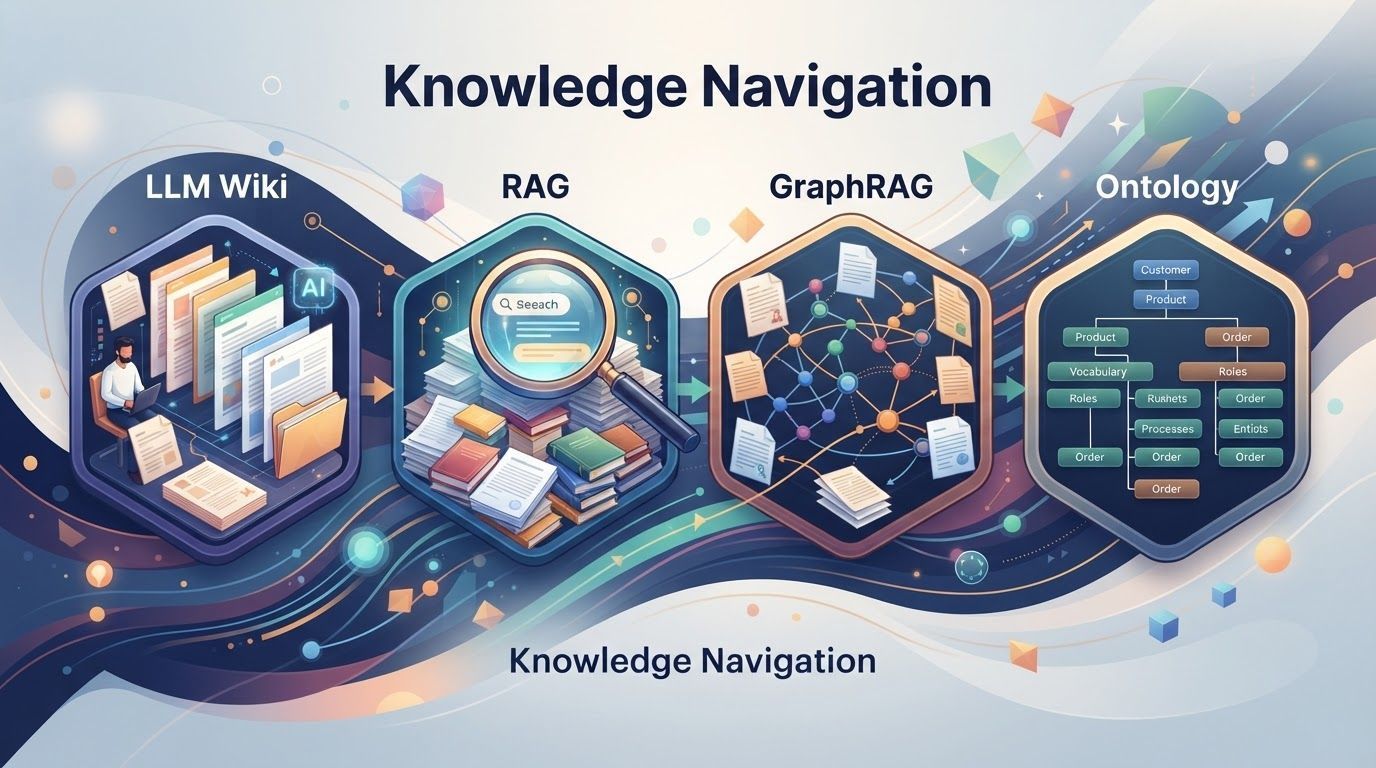
When people build AI knowledge bases, RAG, GraphRAG, LLM Wiki, and ontology often end up in the same comparison. All four help an AI “use” your material, but they solve different problems. One turns source material into maintainable knowledge pages. One retrieves relevant passages from a large document collection. One connects entities and relationships scattered across documents. One gives multiple business systems a shared vocabulary. The choice is not about which name is newest. It starts with the shape of your data and the kind of question the AI must answer.
How the four approaches divide the work
| Approach | Core move | Best-fit question | Typical setting |
|---|---|---|---|
| LLM Wiki | Organize source material into linked knowledge pages under explicit rules | How do I keep personal notes and project experience alive? | Personal knowledge base, small-team playbook |
| RAG | Chunk and embed documents, retrieve relevant passages at question time, then generate | The answer sits in a handful of documents | Policy Q&A, product documentation assistant |
| GraphRAG | Extract entities and relationships into a graph, then retrieve along those relationships | I need to connect entities, dependencies, and owners across several documents | Cross-document tracing, complex business analysis |
| Ontology | Define objects, attributes, and relationships, then map system data onto one model | Different systems mean different things by the same business concept | Customer, order, and product semantics; rule checks |
A rough map helps: personal knowledge management points to LLM Wiki, enterprise document Q&A to RAG, cross-document relationships to GraphRAG, and shared business semantics to ontology. These are not four interchangeable versions of one tool. They operate at different layers, and real projects often combine them.
Personal knowledge: LLM Wiki turns scattered material into linked pages
Start with the personal case. Saved articles, notes, and hard-won project lessons usually live in different folders. After a while, you forget where a particular lesson went, and every new AI conversation begins with another round of context-setting. LLM Wiki addresses exactly this: let an AI organize scattered material into a knowledge base that can be maintained over time.
- Sources: keep collected articles, documents, and project notes in a source folder, with provenance intact.
- Rules: use AGENTS.md to tell the AI how to classify material, how to link it, and what to do with duplicates or conflicts.
- Knowledge pages: the AI turns sources into Markdown pages and links them to one another. 4
A knowledge page is not an isolated summary. When a note mentions a concept, the AI can link that mention to the relevant page. Later, a query can start from the page in front of you and follow links to related knowledge. As material accumulates, the pages form a network of connections.
Where does LLM Wiki fit, and where does it not? It fits personal knowledge bases, small-team project memory, and any setting where people want to read and edit the content directly. Every page is a Markdown file, so it opens and changes easily, and maintenance stays cheap. Its strength is organization and connection, not high-recall retrieval over thousands of policy documents. If a question requires exact quotations from source passages, pair it with RAG. “LLM Wiki” here describes a pattern, not a single product.
Enterprise document Q&A: RAG retrieves first, then generates
Now the enterprise case. A company has thousands of policies, manuals, and product documents. An employee wants the expense reimbursement rule or a technical specification. RAG—retrieval-augmented generation—can be summed up as: find the material first, then have the model answer from it. 1
The two stages of RAG
In the ingestion stage, documents are parsed, chunked, embedded, and stored in a vector database. At question time, the question is embedded too; the system retrieves the most relevant passages and passes them to the model together with the question to generate an answer.
flowchart LR
    docs["Excel / Word / PDF"] --> parse["Parse and chunk"]
    parse --> embed["Embed"]
    embed --> vdb[("Vector database")]
    q["User question"] --> qembed["Embed question"]
    qembed --> search["Similarity search"]
    vdb --> search
    search --> context["Top passages"]
    context --> llm["Model generates answer"]
    q --> llm
If an employee asks, “What is the travel reimbursement limit?”, the system finds the relevant policy in the employee handbook, hands the passage to the model, and lets it compose an answer. It can also return the citation. The answer stays checkable, and the model has less room to invent facts.
Baseline RAG is mature, fast to retrieve from, and able to handle large document collections. It is also straightforward to deploy. Many internal assistants and product-documentation Q&A systems fall into this category.
The limitation appears when the question is not “what does one document say?” but “how do several documents fit together?” Suppose Project A uses a retrieval service, and the data team maintains that service. Ask “who maintains the service Project A uses?” Text similarity may retrieve both documents separately without connecting them. That is where GraphRAG comes in.
Cross-document relationships: GraphRAG adds a graph layer to RAG
GraphRAG differs from baseline RAG by adding a knowledge graph. It first extracts entities and relationships from the documents, then organizes them as a graph. Entities are the named things in the business: projects, people, services, vendors. Relationships are how they connect: who uses which service, who maintains it, what depends on what. Implementations vary—some also cluster the graph into communities and summarize them—but the common move is to extract entities and relationships, then use the graph structure at query time. 2
Return to Project A. One document says, “Project A uses the retrieval service.” Another says, “The retrieval service is maintained by the data team.” Baseline RAG retrieves both documents separately and tries to combine them during generation. GraphRAG extracts two relationships up front: Project A → uses → retrieval service, and retrieval service → maintained by → data team. At question time it starts from Project A, follows the edge to the retrieval service, then to the data team. The answer has a traceable path.
Answering a cross-document question along entity relationships
The graph joins facts from two documents into one path: Project A uses the retrieval service, and the data team maintains that service. Therefore the service Project A uses is maintained by the data team. The final answer still returns to the source evidence.
flowchart LR
    a["Project A"] -->|"uses"| s["Retrieval service"]
    s -->|"maintained by"| t["Data team"]
    d1["Doc 1: Project A uses the retrieval service"] -.-> a
    d2["Doc 2: The retrieval service is maintained by the data team"] -.-> s
Note that the graph supplies a relationship trail, not the final answer. Generation still needs to return to the source documents and show which material supports each edge. If extraction is wrong, the error propagates along the path.
GraphRAG carries a direct cost. It adds entity extraction, relationship identification, and graph construction, plus maintenance whenever the data changes. A bad extraction can affect the whole retrieval path. For ordinary document Q&A, there is no reason to start here. It earns its keep in cross-document queries, multi-hop relationship tracing, and complex business analysis.
Shared business semantics: ontology gives systems one language
LLM Wiki mainly solves knowledge organization; GraphRAG mainly solves relationship retrieval across documents. Enterprises have a harder requirement: make AI across different business systems understand the same set of business relationships. That is the job of ontology. 3
Ontology centers on three things: objects, attributes, and relationships. Objects are the entities of the business—customer, order, product. Attributes describe them: customer name and age, order amount and order date. Relationships connect them: a customer places an order, an order contains a product. Define these clearly, then map data from the different systems onto them, and you get one shared business model.
A simplified customer–order–product ontology
| Object | Attributes | Relationships |
|---|---|---|
| Customer | Name, age, unified identifier | places → Order |
| Order | Amount, order date, status | belongs to → Customer; contains → Product |
| Product | Name, specification, price | contained in → Order |
Take a cross-system example. A company runs a customer system, an order system, and a product system. The same customer may appear under different names and identifiers in each. The order system knows what the customer bought; the product system knows the product details; the records do not necessarily line up. Ontology unifies the scattered business concepts and maps each system’s data onto the same objects and relationships. Now, when the AI is asked “what did this customer buy?”, it does not have to guess what each field means. It can join customer, order, and product through the shared business definition.
Ontology is not only for lookup. You can define business rules in the model and let the system reason and validate against existing data: is this order-status transition allowed, does this customer tier qualify for a given discount? The point is not just linking data. It is giving different systems one shared understanding of the same business fact.
An agent typically uses ontology through function calls. Wrap “query the ontology,” “read an order,” and “look up a customer” as separate tools, with clear names, parameters, and descriptions, and give them to the agent. When the user asks something, the agent decides which tool to call from the question and the tool descriptions. For a shipping status, it calls the shipping tool. For a complex customer–order–product relationship, it calls the ontology query tool. The result then goes back to the model for language generation.
The division of labor is clear. Ontology defines the business concepts and relationships; the agent understands the request, picks the tools, and carries out the query. Without ontology, an agent facing several systems can only guess at field meanings. Without an agent, the ontology is hard to use through natural language.
The two “graphs” are not the same thing
One point causes frequent confusion: both LLM Wiki and GraphRAG produce something called a “graph,” but they are not the same thing.
Two kinds of “graph”
| Dimension | LLM Wiki | GraphRAG |
|---|---|---|
| Where the graph comes from | The AI links knowledge pages while organizing material | Entities and relationships extracted from source documents |
| What a node is | A knowledge page or a concept | An entity such as a project, person, or service |
| What an edge is | A reference or association between pages | A concrete relationship such as uses, maintains, or depends on |
| Main use | Organize and browse personal knowledge; follow links to read further | Cross-document relationship retrieval and path tracing |
| How it updates | Edit Markdown and have the AI reorganize | Re-extract entities and relationships, then maintain the graph |
In one sentence: LLM Wiki connects knowledge; GraphRAG organizes entities and relationships. The first is closer to a map of notes and concepts; the second is closer to a queryable map of business relationships. They can coexist, but they cannot replace each other.
How to choose: look at the data, then at the question
With all four on the table, work backward from the question. Ask what the AI must answer, then where the data lives and what shape it takes, and only then choose the technique.
Choose from the question
| Your question | Start with | Why |
|---|---|---|
| I want AI to organize personal notes and preserve project experience | LLM Wiki | You need maintainable, readable, editable knowledge pages |
| We have many documents and employees need accurate answers fast | RAG | Answers usually sit in a few passages; retrieval is mature and cheap |
| I need to trace entities, dependencies, and owners across documents | GraphRAG | Scattered facts must be connected along entity relationships |
| Our systems disagree about the same business concept | Ontology | You need shared objects, attributes, and relationships, plus rule checks |
| We need document search, cross-system joins, and complex relationship analysis | Combine them | No single technique covers retrieval, relationship tracing, and business semantics |
A common combined architecture
The database holds live business data, RAG retrieves policies and product documents, GraphRAG handles complex relationships, and ontology unifies core business semantics. An agent calls different capabilities based on the user’s question, and the model composes the final answer.
flowchart TB
    user["User question"] --> agent["Agent"]
    db[("Business database")] --> agent
    rag["RAG: policies and product docs"] --> agent
    grag["GraphRAG: cross-document relations"] --> agent
    onto["Ontology: shared business semantics"] --> agent
    agent --> llm["Model composes the answer"]
The most important part of choosing a knowledge-base approach is not which technique is newest or most talked about. It is answering two questions first: what shape is my data in, and what must the AI answer? Personal notes point to LLM Wiki. A large body of unstructured documents points to RAG. Clear entity relationships across documents point to GraphRAG. Multiple systems with a shared-semantics requirement point to ontology. Reverse that order and it is easy to build a graph you never needed, just to use a new tool.
When should you not reach for GraphRAG or ontology? If the question is simply “find the relevant rule in a few documents,” baseline RAG has the best cost-benefit ratio. GraphRAG adds extraction, graph construction, and maintenance, and extraction errors travel along the path. Ontology requires business stakeholders to agree on concepts and keep the mappings governed; the investment is larger than either. Use a simpler approach first to prove that the problem really needs relational reasoning before upgrading.