

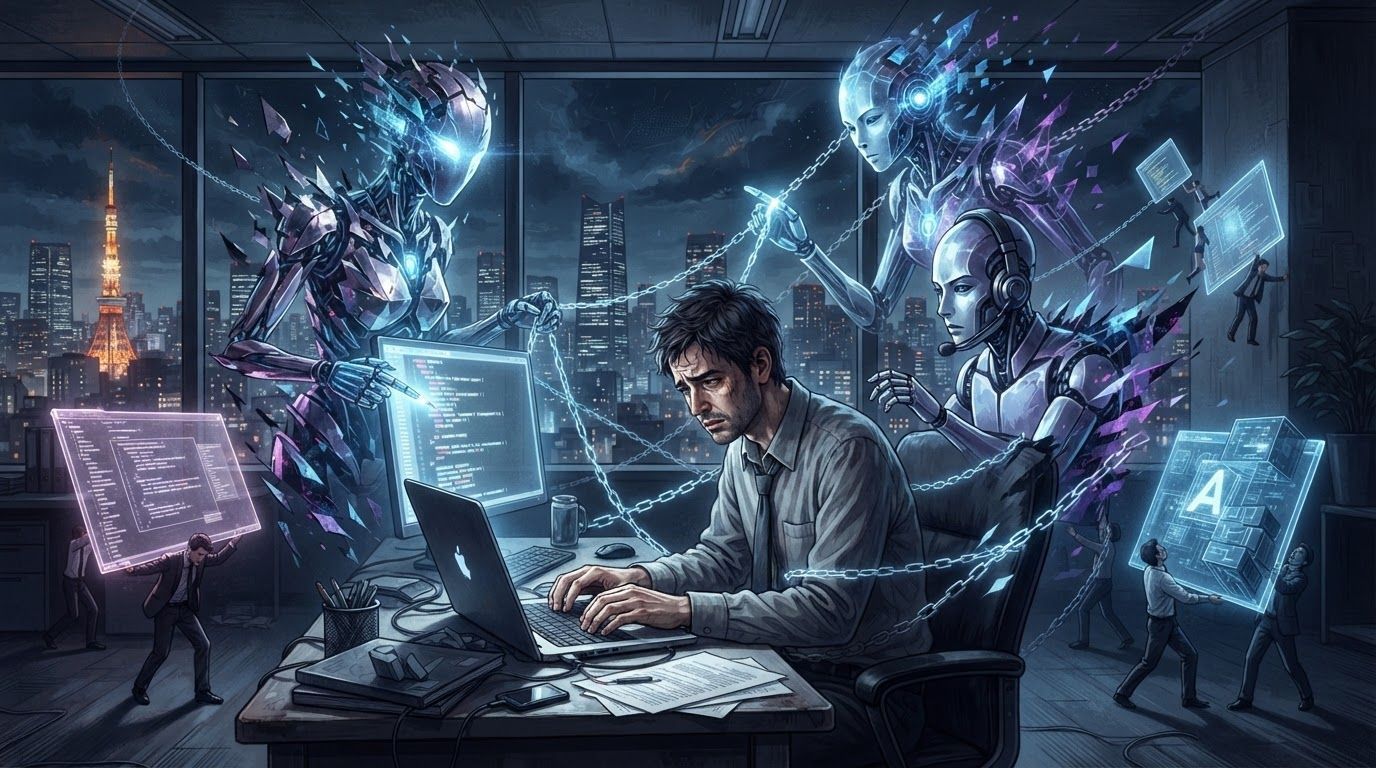
AI Tests Human Nature: Why Tokyo's IT Job Market Is in Chaos
November 2026, Tokyo.
In September I resigned from the company where I had worked for ten years and moved to a new one. Only after stepping out of that environment did I see clearly how frightening Tokyo's IT job market has become. People around me are generally low, and a gloomy mood hangs over the whole industry.
Recently I noticed a strange phenomenon—a kind of social tremor. At first I was carried along by that mood too. But after meeting and talking with more people, I gradually realized that the core cause of this low pressure is AI.
It isn't simply that AI has taken someone's job. What I feel is this: AI tests a person's humanity, deeply and repeatedly.
AI doesn't sort people. It amplifies them.
If a person's heart isn't bad, AI empowers them and they keep getting better. But if a person has a problem in their character—someone who enjoys messing with people, chases petty gains, calculates everything, is especially dark, or habitually exploits others—give them the same tools and they only get worse.
The "badness" I mean isn't necessarily grand villainy. In the job market it shows up as a very concrete kind of boldness: no bottom line. We engineers carry a moral code—this can't be delivered to a client, that can't be fudged, some money can't be earned. They don't think that way. Their boldness comes precisely from having none of those constraints.
We technical people who hold the line and are relatively simple in heart don't have a strong desire to manage people, demand money, or dock their pay. It's the people with that desire who discover that they can throw a few things together, and as long as AI can be bolted on, they dare to do it. The work is mine to pull in, the people are mine to hire casually, the lies are mine to tell casually—I just say we're exceptionally good.
Who is actually running this job market
Much of today's job market is being led by people who aren't technical. They may not understand technology, but they are very good at "working people."
Their business model is simple: pull in the work first, hire a few people at random, tell a few casual lies, and say we're exceptionally good. Once someone is in, they force a project onto you. You're the owner, you need to be responsible, whether you know how or not—just use AI.
What keeps this machine running isn't technical skill. It's nerve and the ability to handle people. You won't fall in line? If you can't take it, leave; I'll replace you. Not enough people? Then I'll borrow from the bank, recruit a crowd, and make them earn for me.
So you get a deeply incoherent picture: there are actually a great many companies hiring, but the people interviewing you and the people coming to interviews are all in the same state—flighty, and frankly low-grade. As long as someone shows up, they fudge them in first. Then a project lands on you: the responsibility is yours, the tool is AI, and whether you can actually do it is your problem. Everyone just keeps muddling through this way.
So the more this IT circle gets stirred up, the worse it feels. This is a new kind of chaos. When something like a weapon is handed to people who are emotionally immature or morally loose, it produces a great many problems of human nature.
Picking out typos with AI is also a power game
Then there's another type, whose way of using AI hurts people even more.
AI writes it—how fast. Once you're done, they go through it line by line picking out typos. The text was written by AI in the first place, yet they insist on checking it character by character, and then use that to make a case: see, you wrote this with AI, you're fobbing me off. Arguing like that is just inflicting psychological pain on someone.
Isn't that sick? Using AI is supposed to move things forward quickly, not to spin in place, and certainly not to show off your authority by using old rules to torment other people. That is vicious.
It's like handing everyone a gun
In the end, AI itself doesn't screen people. People who are emotionally immature, people with a mean streak, get amplified by it.
Maybe the American move to stop AI is right. The truly capable people who could accelerate things can do it with or without AI. The problem is that the vast majority of troublemakers get the same tools, and as a result a lot of things get wrecked.
It's like handing every person a gun and a rocket launcher. Kind people don't shoot easily, but without controls, many people really will shoot—and rob with guns. Then isn't it all over? The world descends into chaos.
Three paths
So what do we do next? I see three possibilities.
One is that someone steps up with a good methodology to channel this. Another is that I study it carefully myself and step up as that person, to make some contribution. And the third is that AI should just stop for now—quit messing around, and everyone should go about things step by step as they should.
I even think that slowing the outbreak of a new industrial revolution may itself be a contribution to humanity. What's the rush? The world's productive capacity is already in surplus, and we're still ramping it up—for what?
The Musk crowd who want to go to Mars can build it themselves with AI and focus on their research. Ordinary people without those tools can live normally without AI. There's nothing wrong with that.
Give creation back to humans
I recall this time last year—vibe coding, programming by feel, wasn't mature yet. Back then I thought, quite innocently: if AI programming really works in the future, that would be something.
But now, compared with that enthusiasm, I have only one thought: I wish this thing would just disappear.
Let those who love to paint paint, those who love to make films make films, those who love to program program, those who love to write books write books. Human creation should be left to humans.