
Cheap Traffic, Rich Margins: The "Combined Model" Behind Three Japanese Companies
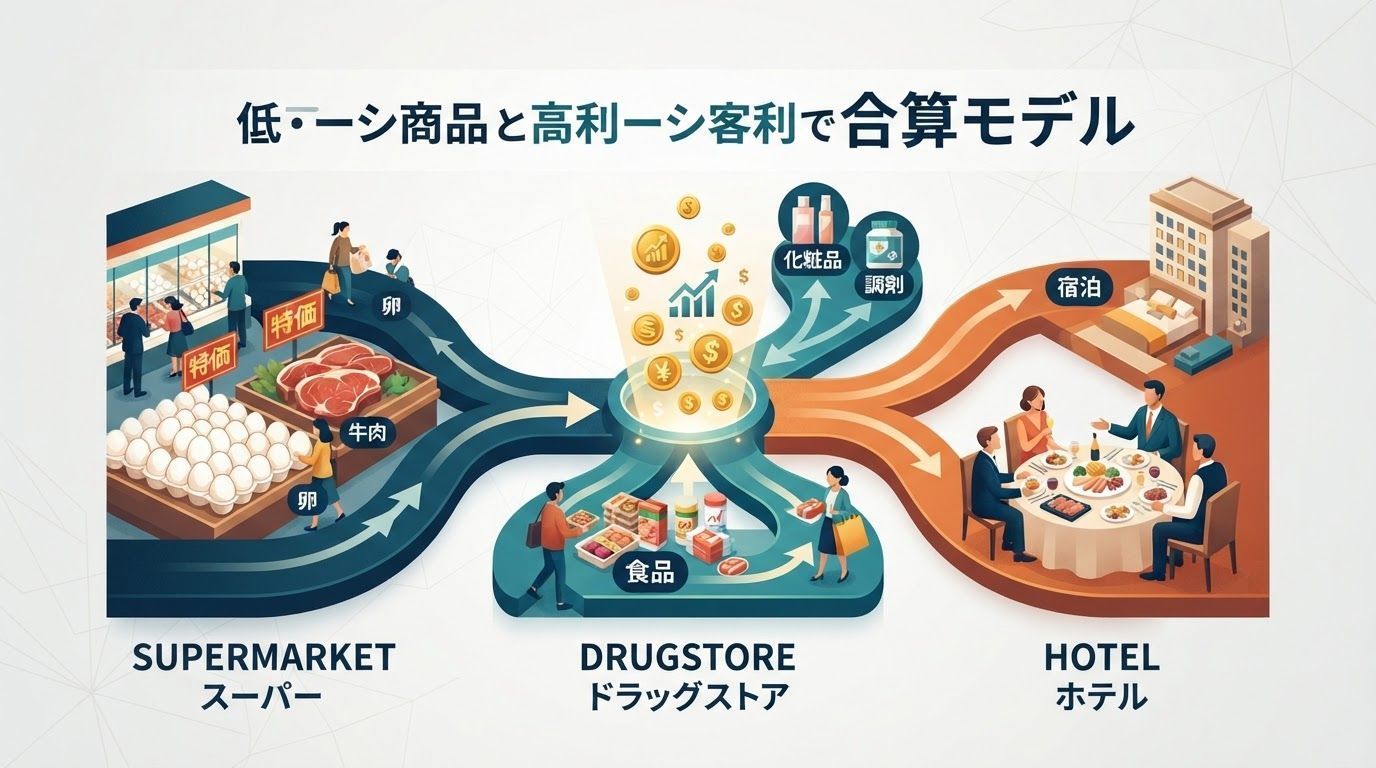
Supermarkets use eggs and beef as loss leaders, drugstores undercut supermarkets on food, and hotels keep restaurants and banquet halls even when they barely profit. The trick is the bundle: low-margin traffic drivers paired with high-margin profit engines. This piece unpacks that "combined model" through Welcia's food-and-pharmacy pairing, Life's shift from specials to private brands and prepared food, and the Imperial Hotel's use of banquets and restaurants to fill high-margin rooms—and lays out the conditions the model needs.

Cheap Traffic, Rich Margins: The "Combined Model" Behind Three Japanese Companies
Supermarkets put eggs and beef in their flyers at prices that barely cover cost. Drugstores sell instant noodles and drinks cheaper than supermarkets do. Hotels keep restaurants and banquet halls as their public face, even when those businesses look weak on margin. Judged line by line, none of this looks like a way to make money. Look at the bundle, though, and the logic appears: pull people in with low-margin items that carry strong perceived value, then monetize them with high-margin ones. Japanese retailers call this structure the "gassan model"—a combined-profit model.
This article breaks the model down through three companies: the drugstore chain Welcia Holdings, the supermarket operator Life Corporation, and the Imperial Hotel. They work in different industries, and their traffic drivers and profit engines differ, but the underlying arithmetic is the same. The first two are textbook examples of the "combined" structure in retail; the Imperial Hotel is a different industry, but the logic of the combination still applies.
Welcia: Food Is the Hook; Drugs and Cosmetics Are the Profit
Welcia's combination is blunt: food and daily necessities bring people in, medicines and cosmetics make the money.
Food accounts for 22.6% of sales, the largest share of any category. In gross profit, however, it accounts for only 14.1%, below medicines at 25.5% and cosmetics at 17.1%. The reason is simple: instant noodles, beverages, and similar foods are deliberately marked down, thinning their gross margin. The goal is to plant the impression that Welcia is cheaper than a supermarket. Food is a high-frequency, price-sensitive purchase—exactly what shoppers compare. Once that impression brings them through the door, they pick up medicines and cosmetics almost in passing. Those categories carry gross margins of 30–40%. This is the "tsuide-gai"—the add-on purchase.
The result shows up in the income statement: Welcia's operating margin holds at 3–4%, above that of a typical food supermarket. It gives up margin on food on purpose and still ends up more profitable overall.
The medicine margin survives because of the barrier to entry. A medicine counter needs pharmacists and registered sales staff (tōroku hanbaisha), and other retail formats cannot easily copy that. It is a clear point of differentiation.
Welcia has a second layer: dispensing (chōzai). Dispensing means preparing medicines according to a doctor's prescription, and in principle only a pharmacist may do it. By placing a dispensing pharmacy next to the store, Welcia lets patients browse cosmetics and daily goods while they wait for their medicine. The convenience itself becomes a reason to visit. Nearly 80% of Welcia stores now have a dispensing pharmacy attached, and the network exceeds 2,200 dispensing stores. For comparison, Ain Holdings, a major dispensing chain, has about 1,200. Dispensing also carries a gross margin above 30%, making it another source of profit.
Food pulls people in, medicines and cosmetics monetize them, and dispensing keeps them coming back. Only with all three layers together does Welcia's model become visible. No single layer explains why it earns more than an ordinary supermarket.
Life and the Japanese Supermarket: The Limits of Loss Leaders, the Rise of Prepared Food
Life Corporation is the second case. Its pivot, in short, is from "loss-leader specials" to stronger private-brand products. To understand that pivot, you first need to see how Japanese supermarkets use specials.
The standard play is high-low (Hi-Lo) pricing: put eggs, fresh meat, and similar items on special, advertise them in flyers, and pull customers into the store. Shoppers come for the deal and buy other items along the way. The special is the hook; the loss is recovered through the margin on everything else. Because the same item's price rises and falls from day to day, the industry calls this Hi-Lo.
Eggs and fresh meat are favored as loss leaders because they are bulky and perishable. Shoppers are less likely to trek from store to store comparing prices, and more likely to buy in bulk once they are there. The art of assortment is to choose a hook from the category where "once you've come, it's hard to leave empty-handed."
There is an accounting trap here that is easy to miss. Fresh food looks like a profit pillar by sales share and gross margin. But processing, freshness management, and spoilage costs are not fully reflected in the gross margin. Whether fresh food actually makes money at the operating-profit level varies widely from chain to chain. A high gross margin does not mean the category is profitable.
What the industry is really betting on is prepared food (sōzai). Prepared food adds the value of cooking, so it can be priced above the raw goods a store buys in. Aging, more dual-income households, and growing demand for time-saving meals keep expanding the market. It has two more advantages: changing ingredients can dodge commodity-price spikes, and a well-made original product is itself a traffic draw. That is why chains are stepping up investment in central kitchens and process centers.
The opposite route is EDLP—everyday low price. No specials; instead, relentless operational efficiency, logistics included, keeps costs down, and the savings go into price. OK Store is the textbook case: compared with Life, its gross margin is lower, but its selling, general, and administrative expense ratio is lighter. Both routes work. The difference is where the profit comes from—Hi-Lo earns it through the bundle and the calendar, EDLP through efficiency and scale.
Life's "from specials to private brands" fits this frame: rely less on discounting national brands and shift toward products the company can price itself. Private brands and prepared food are two moves on the same path, turning "selling someone else's goods cheaply" into "creating margin with our own products."
Imperial Hotel: Restaurants and Banquets Are the Face; Lodging Pays
The third company is the Imperial Hotel, which combines lodging, banquets, and restaurants. Grand hotels such as the Imperial Hotel Tokyo, Hotel Okura Tokyo, and Hotel New Otani broadly follow this structure.
Lodging is the biggest profit source. The essential costs of selling a room are commissions to travel agencies and booking sites, plus utilities and cleaning. The Imperial Hotel does not disclose segment profit, but according to interviews, the gross margin on lodging reaches 80% to nearly 90%.
Banquets come next, but they split into two kinds. General corporate banquets are mostly labor cost and carry a high margin. Weddings add outsourced costs for attire and makeup, which thins the margin. Restaurants have the lowest margin of all: food cost and chefs' labor weigh heavily.
On a standalone basis, neither restaurants nor weddings look like good businesses. But they are the hotel's face. Banquets and weddings generate exposure, bring in one-time visitors, and sustain the brand. In 2020 the Imperial Hotel launched a photo-wedding package: couples can shoot wedding photos in a suite and the main lobby of the main building, and stay a night in the suite. Photos spread easily on social media, raising the hotel's profile and holding down advertising spend. A wedding is a one-time purchase, but the couple may come back for anniversaries—for a stay or a meal—for years.
So the Imperial Hotel's logic runs like this: use low-margin, high-exposure banquets, weddings, and restaurants to sustain the brand and the flow of guests, then convert some of that flow into high-margin lodging guests. The low-margin business is not a burden here; it is the cost of customer acquisition.
The contrast is the "lodging-only" hotel, such as APA Hotel or Toyoko Inn: cut restaurants and banquets, or keep them to a minimum, and focus on rooms. The cost structure is completely different from the Imperial Hotel's. Lodging-only is not limited to business hotels; foreign-affiliated and new domestic city hotels at higher price points often use the same format.
What the Model Requires
Three companies, three combinations, one calculation: lower the threshold with an entrance that is credibly cheap, then collect the profit through a high-margin item protected by a barrier.
But a bundle is not magic. The model needs at least three conditions. Customers must genuinely perceive the traffic driver as cheap. The high-margin item must have a barrier—qualifications, location, brand, or switching costs. And the traffic must convert into purchases of the high-margin item, with the return covering the cost of pulling people in. Remove any one, and the bundle degenerates into a plain discount.
The direction of change at all three companies is also telling. Welcia moves from food toward dispensing; Life from specials toward private brands and prepared food; the Imperial Hotel from banquets and weddings toward photo weddings and repeat lodging. The common move is from selling goods to selling experience, time, and relationships. It is not about cutting the low-margin business. It is about answering the question again: which part of the business makes friends, and which part makes money.