

Both Sell Cheap. They Earn in Different Places: Gyomu Super vs. Costco
Cheap Is Not a Subsidy: Three Margins on One Product
In the fiscal year ended October 2025, Kobe Bussan reported revenue of ¥551.7 billion, operating profit of ¥39.9 billion and an operating margin of 7.2%. It sells tofu for a few hundred yen, frozen fried rice and bulk condiments, and its prices sit permanently on the cheap side. Yet the low price has not eaten the profit. The question is not why it can sell so cheaply, but where it makes the money while doing so. 3
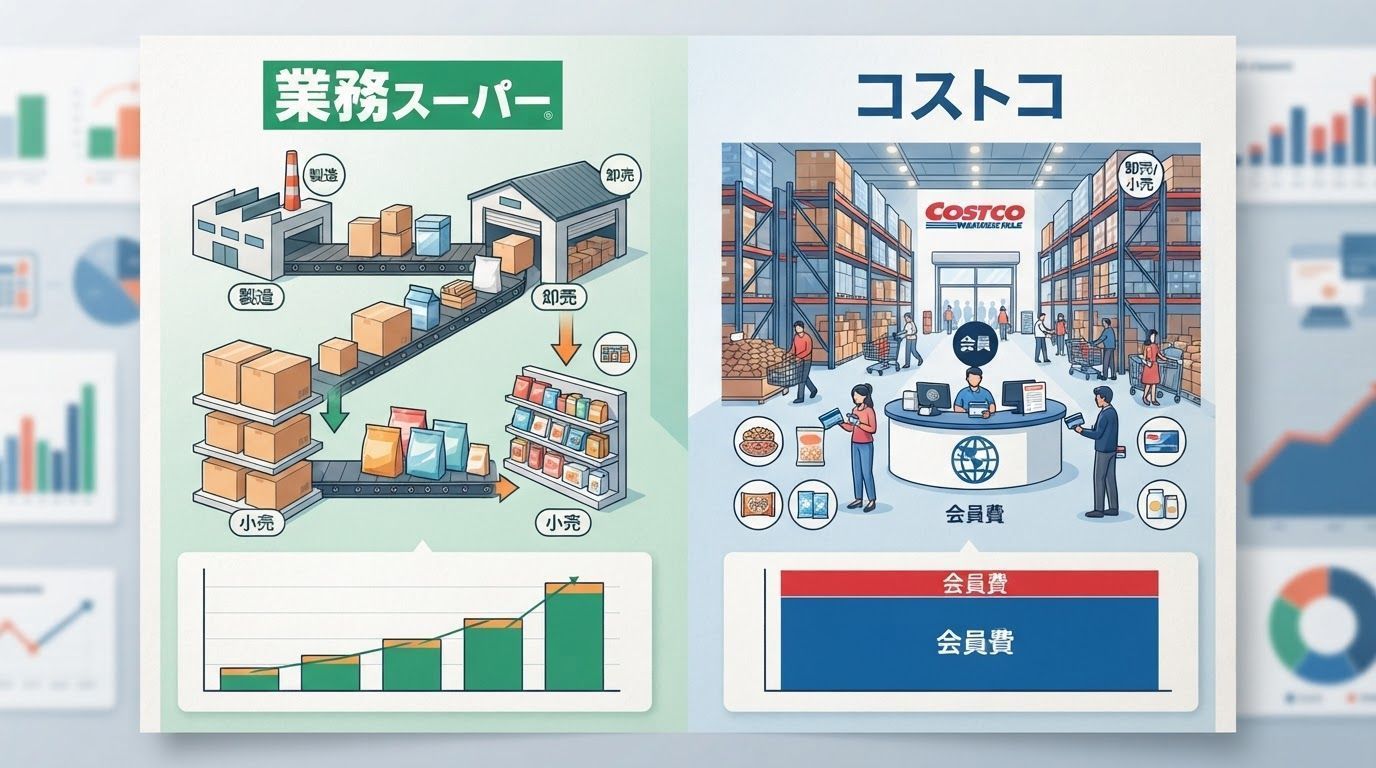
Break the business down and three transactions sit on the same product flow: low-margin retail in the form of wholesale to franchisees, an ongoing franchise fee tied to purchase volume, and manufacturing profit from private-brand products developed, made and sold by the group. Stores handle only the last step. The profit sits behind them, in factories, warehouses and contracts. 1
Kobe Bussan's Three-Layer Profit Structure
Most Gyomu Super stores are run by franchisees; by the end of October 2024, the chain had 1,084 stores in Japan. As the franchisor, Kobe Bussan buys goods centrally and wholesales them to those stores; the stores sell at the price system set by headquarters, which earns both the wholesale spread and the franchise fee. Because headquarters is also a manufacturer, it controls both the source of supply and the store network. 1 2
What each transaction model earns 1 2
| Model | Where the revenue comes from | Margin profile | Main risk |
|---|---|---|---|
| Low-cost retail (wholesale) | Wholesale of goods to franchisees | Thin margin per item, earned through turnover and scale | Inventory, price competition and franchisee sales |
| Ongoing contract (franchise fee) | Royalty of 1% of the purchase amount | Costs barely rise with volume | Franchisee performance and regional terms |
| Manufacturing (private brand) | Development, production and sale through own and partner factories | Development and production costs are controllable; margin above pure wholesale | Quality control, raw materials and currency |
If the franchise fee is 1% of purchases, where does headquarters actually earn? 1 The 1% is easy to misread as 1% of sales. Gyomu Super's franchise materials say "1% of the purchase amount" — 1% of what a franchisee buys — and the terms differ between Hokkaido, Kanto, Kansai, Kyushu and other regions. That 1% alone would struggle to cover product development, logistics and store support. Seen as a structure, the main revenue is the wholesale spread: headquarters organizes food factories and overseas suppliers and delivers goods to franchisees at a lower cost. A low fee makes it easier for franchisees to open stores; more stores mean more wholesale volume and more bargaining power upstream.
How goods and money move 1
Factories deliver to headquarters, headquarters wholesales to franchise stores, and stores sell to consumers. The franchise fee flows back by purchase volume. Manufacturing, wholesale and contract revenue each land in a different part of the chain.
flowchart LR
    factory["Own and partner factories"] --> hq["Kobe Bussan (franchisor)"]
    hq -->|"Wholesale"| store["Gyomu Super franchisee"]
    store -->|"Sale"| customer["Consumer"]
    store -.->|"Royalty (1% of purchases)"| hq
    hq -.->|"Private-brand manufacturing"| factory
Private Brands and Own Factories: Burying Cost in the Product
The second support is turning products into private brands. As of 2024, private brands were about 34% of Kobe Bussan's sales. Roughly a third of sales value comes from private-brand items that headquarters helps plan and designated factories produce. Because a private brand skips the national-brand margin, headquarters can negotiate cost directly with the factory and pass part of that space into price. 2
Factories support that ratio. Kobe Bussan has about 27 food-processing sites in Japan and works with partner factories in roughly 50 countries. Many ingredients, from eggs and dairy to frozen foods, are processed inside the group before becoming private-brand products. It also buys struggling food factories, acquiring not only equipment but recipes and production know-how. In effect, it runs retail with the methods of a manufacturer. 2 1
- Planning, manufacturing, logistics and sales sit in one chain, cutting intermediate markups
- Making private brands in volume stabilizes raw-material purchasing and factory utilization
- Imported ingredients and domestic factories back each other up, reducing dependence on one origin 2
The Costco Contrast: Profit at the Door or in the Supply Chain?
Move the lens to the United States, and Costco achieves everyday low prices another way. In the fiscal year ended August 2024, net sales were $249.6 billion and membership-fee revenue was $4.8 billion. It operated about 890 warehouses worldwide, 35 in Japan, and had 76.2 million paid members with a 90.5% worldwide renewal rate. Gross margin on merchandise was only 10.9%, yet operating profit reached $9.3 billion. 5 6 7
Two cheap businesses, two places where profit lands 5 6
| Dimension | Kobe Bussan (Gyomu Super) | Costco |
|---|---|---|
| Who runs the stores | Mostly franchisees | Company-operated warehouses |
| Main revenue | Wholesale and private-brand manufacturing | Merchandise sales plus membership fees |
| Profit anchor | Manufacturing and wholesale spread upstream | Membership fees, with almost no cost of goods |
| How low prices hold | Own factories, private brands, centralized buying | Narrow assortment, large packs, high turnover |
| How it expands | Recruit franchisees, add factories | Open warehouses, grow membership |
The $4.8 billion in membership fees equals 52% of the $9.3 billion operating profit. The cost of serving members barely rises as merchandise volume grows, and renewal stays above 90%. That is why Costco can keep merchandise gross margin near 11%: it charges once at the door, then gives members a reason to come back and "earn the fee back." Kobe Bussan has no such door. It has to save and earn at every stage the product passes through. 5 6
Where the Model Stops Working
The first condition is currency and raw materials. Imported goods are 20–30% of Kobe Bussan's range, and many ingredients in domestically made products are imported too. A weaker yen raises purchase costs directly, while EDLP leaves little room for frequent price increases. Between the fiscal years ended October 2012 and October 2024, the yen fell from ¥80 to ¥152 per dollar, yet operating profit grew 8.1-fold. Private brands and own factories absorbed part of the shock. That does not mean currency risk disappeared; it was deferred and spread across a longer chain. 2
The second condition is franchisee quality. Franchising lets headquarters open stores with little capital, but site selection, operations and service belong to the franchisee. Headquarters takes 1% of purchases, so the loop only works if franchisees make money first. As store density rises, competition for the same customers, regional differences and franchisee exits all feed back into wholesale volume. 1
The third condition is valuation. In November 2026, Kobe Bussan's market capitalization was about ¥868 billion and its PER about 23. The price embeds three expectations: that it keeps opening stores, keeps raising the private-brand ratio and keeps defending its margin. If any one stalls, the valuation adjusts before the earnings do. "One trillion yen" is a widely quoted scale, but market capitalization moves with the share price; it is not a fixed coordinate. 4
- Whether the private-brand ratio stays above 30%
- Whether domestic factories and overseas suppliers can keep absorbing a weak yen
- Whether sales per store grow as the franchise network grows 1 2