

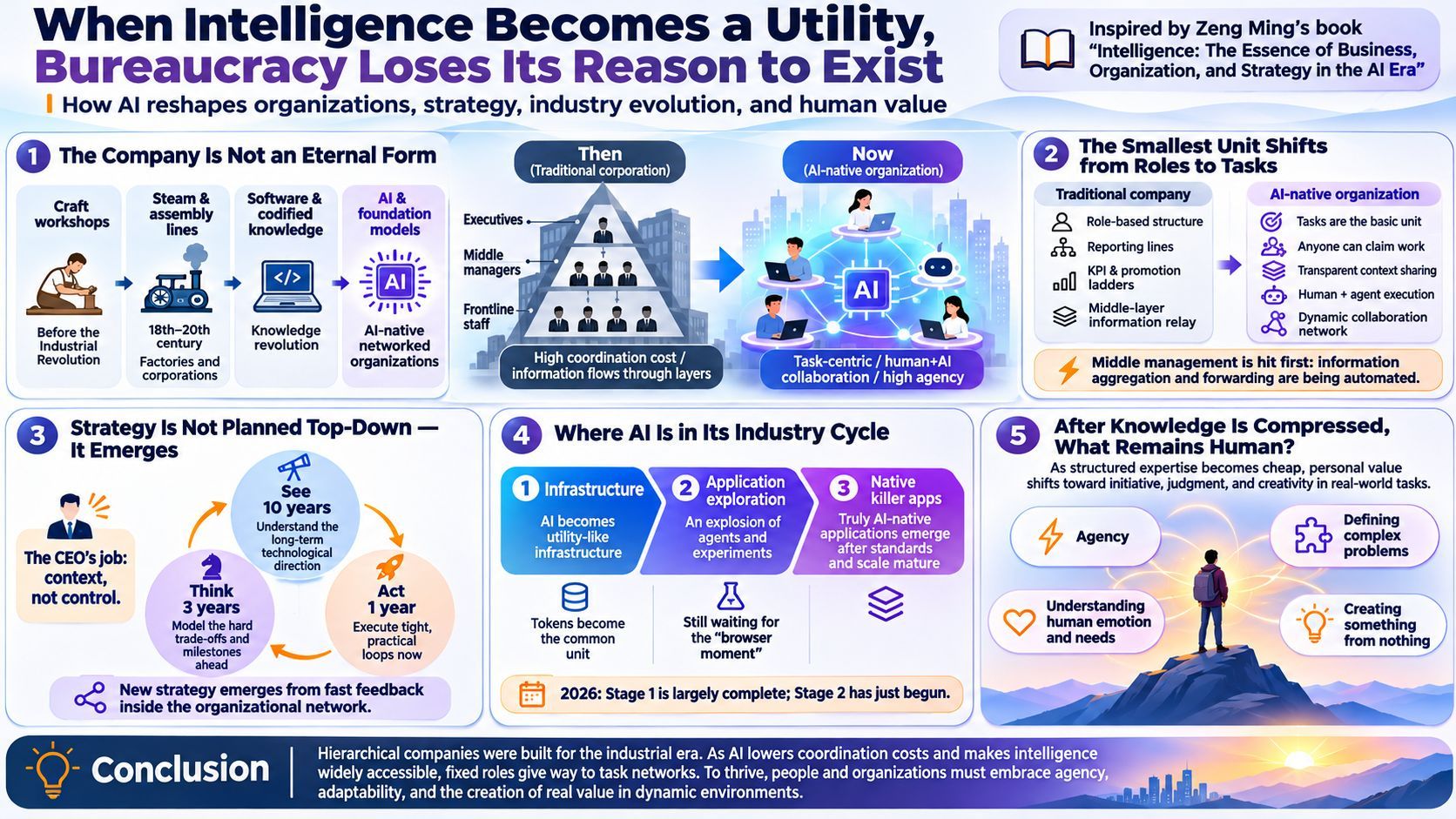
When Intelligence Becomes a Utility, Hierarchy Loses Its Reason to Exist
In his new book *Intelligence: The Nature of Business, Organization, and Strategy in the AI Era*, Zeng Ming offers a piercing judgment: the corporate system and hierarchical management invented in the industrial age are heading toward obsolescence.
This is not an emotional prophecy. In his framework of business dynamics, every great leap in productivity rips out the organizational container of the previous era. The steam engine tore down the craft workshop; the assembly line remade the factory. And when large models turn general intelligence into infrastructure like running water and electricity, the underlying operating logic of the business world has no choice but to change.
The Company Is Only Two Hundred Years Old — It Is Not a Law of Nature
Many people treat “going to work at a company” as the natural way to survive. But business history says otherwise: the modern corporation is barely more than two hundred years old. Before the Industrial Revolution, human society had only scattered craft workshops. It was the steam engine and the electric assembly line that, in order to organize thousands of workers for standardized production, gave birth to the hierarchical company.
Peter Drucker divided the history of the industrial era into three stages. The first was the productivity revolution: the assembly line replaced the craft workshop, and the efficiency of manual labor rose sharply. The second was the management revolution: about a century ago, modern management theory and business schools emerged, training professional managers to support the expansion of multinational giants. The third was the knowledge revolution: from the 1970s, the software industry rose, its core being the codification of human experience and best practices.
In the AI era, the business world is stepping into a fourth stage: the creativity revolution.
Large models are taking over, at extraordinary speed, all knowledge work that can be structured and processed as a workflow. Industry experience can be compressed wholesale into a model. Companies that ran on information asymmetry plus layered reporting lose the economic rationale for their high coordination costs. In other words, the decline of the hierarchical company is the inevitable result of productivity washing away an old set of production relations.
The Smallest Unit of Organization Shifts from the Job to the Task
The smallest physical unit that keeps a traditional company running is the job. To grow, a company first sets its org chart, defines job responsibilities — the job description — and then hires accordingly. Jobs are what make reporting lines, promotion paths, KPIs, and salary bands possible.
In an AI-native organization, the basic operating unit is not the job. It is the task.
Leading AI teams today, Anthropic among them, have no long HR hierarchy. They have dropped titles like vice president and director; everyone is simply called a “technical researcher.” Each day begins with concrete goals: get a new model working, build an evaluation suite, optimize an algorithm. These tasks sit on a transparent internal network. No one distributes them layer by layer. Whoever can solve a problem claims it, takes their agent, runs tests, changes code, and delivers a verifiable result. The feature ships.
The org structure shifts, too — from a fixed hierarchical pyramid to a dynamic, self-adapting neural network. Teams shrink sharply. Everyone needs a high degree of agency: use AI as leverage to become a super-individual, then collaborate deeply with others.
Why does middle management go first? Because the most primitive function of a hierarchy is to aggregate and relay information. Once context can be shared across an organization and tasks can be claimed directly on a network, a job that does nothing but relay information loses its reason to exist. This is not a matter of management style. It is what happens when technology reprices coordination costs.
Strategy Is Not Planned. It Grows.
In the traditional view of many entrepreneurs, strategy comes first and organization second. Zeng Ming reverses the order in his book, putting the organizational question ahead of the strategic one.
The reason is simple: an old organization cannot grow a new strategy.
When the external environment changes by the month, even the week, a five-year plan produced by a board over several months — or a strategy report commissioned from a consulting firm at great expense — no longer works in the AI era. Strategy cannot rely on closed, top-down planning. It has to emerge from the organizational system itself. Great strategic insight comes from high-frequency collisions and real-time feedback inside the organization’s neural network.
The CEO’s job is to build an environment rich in context — “context, not control”: give everyone and their AI a shared long context, align vision and understanding, and let the best decisions emerge on their own.
For the rhythm of strategic thinking in the AI era, Zeng Ming offers a core framework: look ten years out, think three years ahead, execute one year at a time.
Looking ten years out means seeing the technological endgame and the direction of civilization, and making sure you are pointed with the big trend. Executing one year at a time means focusing on the smallest viable closed loop in front of you and moving with agility. Thinking three years ahead is the hardest cognitive leap.
In a period of exponential change, linear extrapolation is bound to fail. You have to force yourself to reason out the next two or three milestones, and to see the violent conflicts and trade-offs among short-term interests, medium-term survival, and long-term goals. Strategy is, at its core, trade-offs. Without the three-year projection, founders fall into one of two traps: they either wallow in illusory short-term metric growth until they hit a ceiling and fall off a cliff, or they aim too high, declaiming about the stars ten years away while failing to find an entry point today.
Where AI Actually Stands: The Infrastructure Is Built; Applications Are Waiting for Their Browser Moment
Pull the lens back from the micro-organization to the long cycle of general-purpose technology, and the question becomes: where exactly is the AI industry today?
Zeng Ming sorts the diffusion of every disruptive general-purpose technology into three stages. In the first, the technology is broadly accepted by society and gradually becomes infrastructure. In the second, a vast wave of application exploration builds on that infrastructure and blooms. In the third, after applications flourish, the underlying operating model is rebuilt from the ground up and true native killer apps are born.
2026 is precisely the inflection point where the first stage is essentially complete and the second has just begun. The signal is that token has become the agreed unit of measure.
Like a kilowatt-hour of electricity, a ton of water, or a gigabyte of data traffic, once a technology has a standardized unit, it becomes public infrastructure in earnest. In commercial terms, the endgame for large-model companies is clear: AI cloud companies under oligopoly and strong government regulation. Economics has an iron law — once supply becomes homogeneous, no company can sustain excess monopoly profit, and prices fall toward marginal cost. As the capability gap between models converges, the model itself becomes plumbing and electricity on tap.
Many technical people find this hard to accept: their model technology is so advanced, yet the margins are so thin. The root cause is that this outcome violates the laws of economics.
Agent applications today are at the dawn of the second stage. Zeng Ming compares the current agent boom to the early internet of 1992–1993. The 1992 wave was about building websites; its core was sharing information, and it ultimately drove the digitization of all human knowledge. Today’s wave is about building agents; its core is sharing capability — packaging an expert’s workflow into an agent that is ready to use.
Many people are anxious that no killer agent app has appeared yet. But put this in historical coordinates: we have not even reached this era’s “browser.”
When Netscape’s browser was born, it accomplished two crucial things. First, HTML established a unified standard, letting anyone build a site with a low barrier to entry. Second, it brought the barrier for ordinary people to browse the web down to zero. Supply and demand exploded overnight, and Yahoo and Google followed. Today, however, we still lack a super entry point with a unified standard for how agents interact and are invoked.
In Zeng Ming’s projection, the true native killer apps — the TikTok and Pinduoduo of the mobile internet era — tend to arrive in the third stage, after the second has fully flourished. That may still be eight to ten years away.
In this long campaign, the first thing application-layer founders should do is abandon the playhouse approach of cobbling together simple tools. Assume baseline intelligence is fully sufficient. Go into vertical, complex, real business scenarios, and build your intelligence moat by solving hard problems.
After Knowledge Is Submerged, All That Is Left for Humans Is Creativity ex Nihilo
As hierarchy recedes, organizations are rebuilt, and baseline intelligence is available to everyone, where does the relationship between people and systems go?
If the industry experience a person accumulated over twenty years is, in essence, rules and routines that can be summarized, then in front of a large model, the premium on that experience is heading toward zero.
But this is exactly the most exciting turning point for human civilization.
Much of the white-collar work of the industrial age was filled with dull, repetitive, tedious data shuffling and approval flows. People felt drained and unhappy at work because they were fixed in place like screws on a workstation, spending their limited energy catering to top-down control.
Once AI takes over structured knowledge, humans can finally step out of rote process execution and face the one core asset that cannot be computed: the creativity to make something out of nothing.
That creativity goes beyond execution — beyond writing code or drawing a picture. At its core is a deep understanding of human emotion and need, a sharp definition of complex problems, and the building of unprecedented connections between seemingly unrelated elements.
Against a wave this large, history will prove again and again: old giants rarely get a natural ticket to the new era. For individuals, the only way to survive this era is to let go of illusory pride and certainty, embrace change with high autonomy, and rebuild personal value through real-world tasks.