
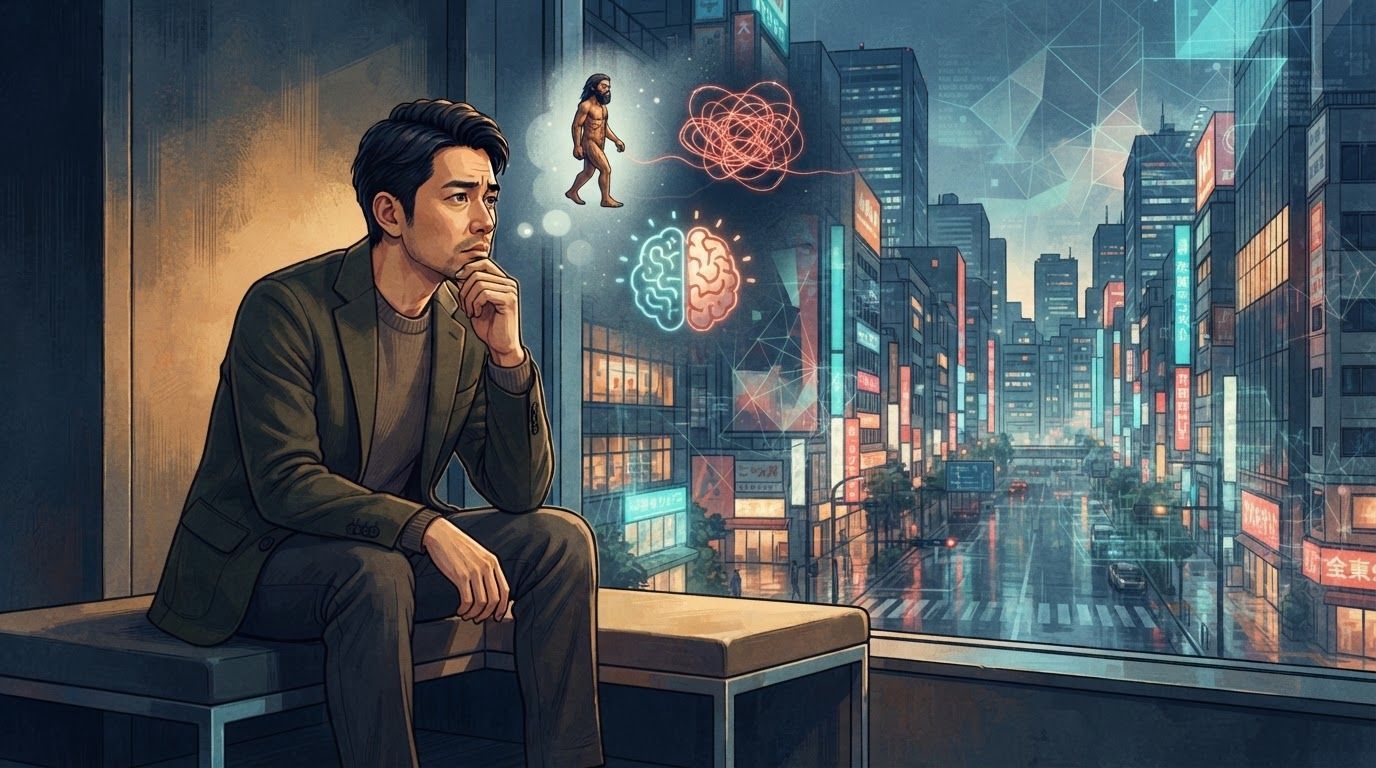
Forty, in Tokyo: Anxiety, Uncertainty, and a Reset of Mindset
At forty and living in Tokyo, the author keeps running into the same problem during a career transition: when things don't go as planned, a sense of losing control pulls him into self-doubt. Psychology calls it intolerance of uncertainty, and having a name for it comes as a relief. Drawing on evolution, he explains why humans are wired to stay alert, how catastrophic thinking mistakes the worst case for fact, and how separating hypothesis from fact and returning attention to the present can help. He also examines how the AI era adds fuel to the fear of being replaced, arguing that the shift should be from competing with AI to harnessing it, and that this is not a burden individuals should carry alone.

Forty, in Tokyo: Anxiety, Uncertainty, and a Reset of Mindset
I'm 40 this year, living in Tokyo. A career transition, combined with the fast pace of this city, has meant that lately I keep running into the same problem: when things don't go as expected, that sense of losing control quickly drags me into self-doubt — am I simply not someone who can handle things?
To understand how that feeling forms, I read a fair amount, and found that psychology named it long ago: intolerance of uncertainty. It describes the discomfort people feel when they can't predict the future, and the tendency to keep seeking a definite answer.
Knowing the definition actually came as a relief. It at least showed me that this isn't a personal character flaw, but a psychological mechanism with a history behind it.
Why humans are wired to hate uncertainty
This psychology isn't the isolated behavior of one individual; it's a condition humans have carried from primitive society all the way to today. Why are we like this? Start with evolution.
Imagine an ancient human hearing a rustle in the grass. He doesn't know whether it's the wind or a predator. If he becomes alert at once and is wrong, the cost may be nothing more than a needless scare. But if he isn't alert at all, and is wrong, the cost could be his life.
So from an evolutionary standpoint, staying alert to potential danger has adaptive value. The problem is that this alert system, built to cope with survival threats, doesn't switch itself off once the environment becomes safe. In modern society, problems that can't be resolved immediately — waiting for exam results, a job offer, investment returns — activate the same system. These things may not pose an immediate physical danger, but they can still keep a person in a state of constant vigilance.
That is probably where the "sense of losing control" comes from: the alarm is real, but the danger isn't in front of you.
Catastrophic thinking: mistaking the worst case for fact
If intolerance of uncertainty is the background, what amplifies the anxiety further is "catastrophic thinking."
It's an over-sensitive protective mechanism left over from the brain's evolution. It automatically rehearses the worst outcome, then treats that outcome as something certain to happen. The results aren't out yet, but your mind has already played the scene after failure through to the end; the résumé you sent hasn't drawn a reply, and you're already imagining the worst ending.
Knowledge workers like me fall into this trap especially easily. Our work is precisely to anticipate risk in advance and design remedies. People who make a living from that ability find it hard to switch it off after hours. So the risk instinct honed by the job gets turned back on one's own life: being alert to risk at work is professionalism; repeatedly rehearsing life outcomes that haven't happened yet is just depletion.
Separate "hypothesis" from "fact," then bring your attention back to the present
To dismantle this mindset, the first step is to recognize: that worst outcome is, for now, only an unreasonable hypothesis, not a fact that has already happened.
The second step is to force your attention onto the present you can control. My method is to record one small thing each day that moves things forward — nothing dramatic required: finishing a paragraph, sending an email, going out for a walk. The point isn't to solve the problem immediately, but to pull attention away from "outcomes I can't control" and back to "what I can do today," rebuilding a sense of safety and control bit by bit.
Still, easier said than done. I don't want to offer only grand principles. When anxiety hits, reason knows what to do, but the body doesn't always cooperate. This method isn't a switch; it's more like practice: you manage a little today, you may slip back tomorrow, then you pull yourself back again.
In the age of AI, anxiety has new fuel
In real life — especially in this broader AI-driven environment — this anxiety is easily intensified further.
Because it's far too easy to compare AI's efficiency with our own "irreplaceability." Watching it finish an article in seconds or organize a stack of material in minutes, then looking back at what took you a whole day, the fear of being replaced surfaces. What's worse, that comparison often uses the wrong yardstick: we measure human worth by the dimension AI is best at — speed, efficiency, output — and then conclude that we're "not good enough."
To dismantle this mindset, the center of gravity has to shift from "competing with AI" to "how to harness AI." As I see it, people can bring their distinctly human creativity, empathy, and strategic thinking into play, and use AI as an aid to efficiency rather than a mirror for measuring themselves. Value doesn't have to rest on "being faster than the machine"; it can rest on "knowing what to have the machine do."
This isn't something one person can solve alone
But then again, this isn't a problem anyone can solve by themselves.
I actually think this may be a social, systemic transformation — a big event for humanity. I'm just feeling the cold wind a little early. And precisely because of that, I'm reluctant to blame all of the anxiety on individual mindset: if the structures are changing and the rules are changing, yet every person is expected to get through it by "looking on the bright side," that's just transferring a systemic problem onto individuals.
The parts I can adjust, I adjust seriously; the parts I can't, I at least try to see clearly for what they are. That's probably about all I can do right now.
A final note
That's all for today. I'm still adjusting myself, and if I find something that works or gain some experience from it, I'll bring it back and share it with everyone then.
A hard winter is coming. I hope everyone gets through it safely. Best of luck to all of you — and to myself.