
Three Recurring-Revenue Models: How OBC, McDonald's Japan, and BayCurrent Make Money
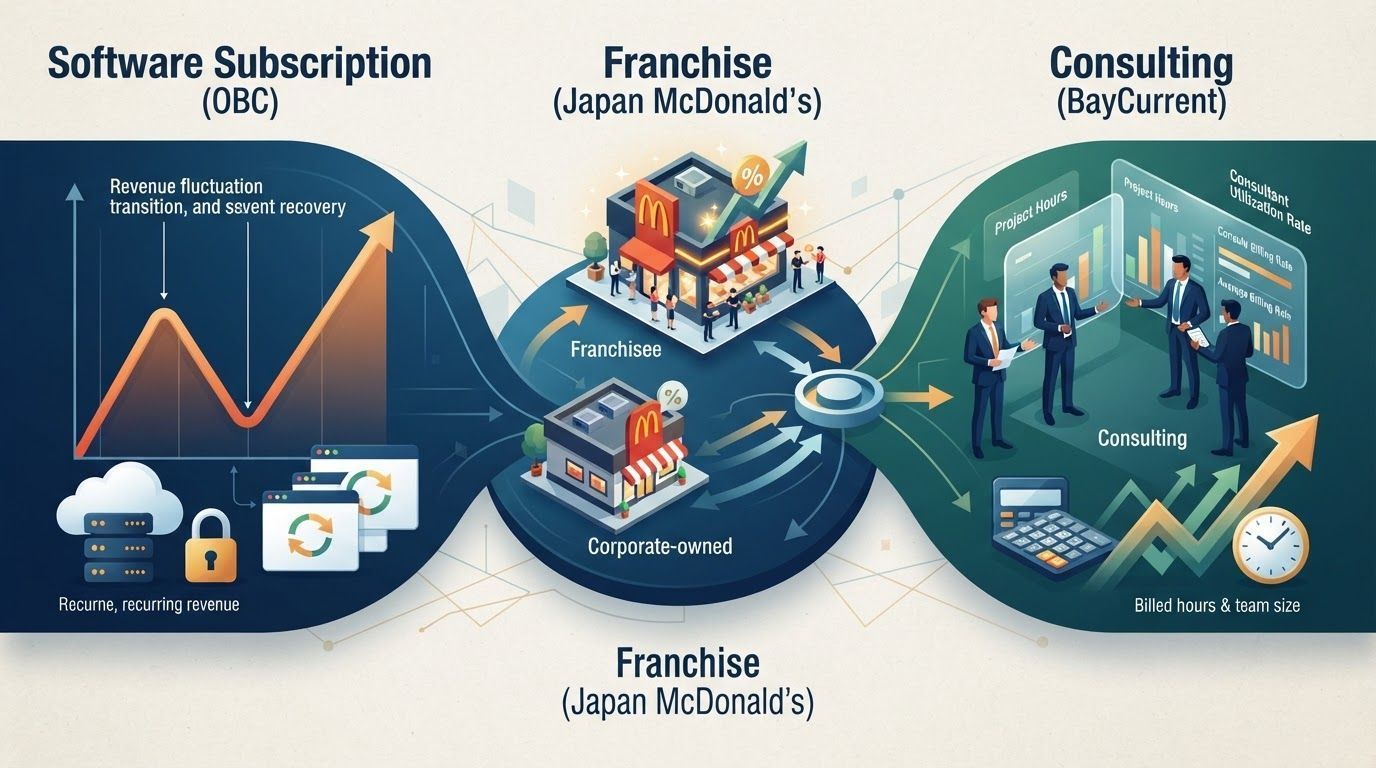
Three companies, three ways to turn one-off sales into recurring revenue. OBC weathered a volatile cloud transition before a V-shaped recovery; McDonald's Japan earns a higher gross margin from franchising than from company-owned stores; BayCurrent's revenue comes down to price, headcount, and utilization. The article breaks down the cost structures and risks behind each model.

Three Recurring-Revenue Models: How OBC, McDonald's Japan, and BayCurrent Make Money
A one-off sale rises and falls with each deal. Sell a lot, and profit looks strong this quarter; sell little, and the next quarter suffers. Recurring revenue spreads income across time: as long as customers stay, the money keeps coming. But recurring revenue does not guarantee profit. The three Japanese companies below have built recurring income through software subscriptions, franchising, and consulting—and each pays a different price for it. They charge different customers, carry different costs, and bear different risks.
OBC: Turning Accounting Software from a One-Off Purchase into a Subscription Means Weathering Revenue Swings
OBC (OBIC Business Consultants) is best known for its flagship accounting software, Kanjō Bugyō. Traditionally, it ran a classic on-premise business: selling servers, dedicated terminals, and software, then providing maintenance. The problem with that model was not the price but the rhythm. Accounting software can cost hundreds of thousands of yen, so customers do not switch lightly. Upgrades meant buying a new version during a major release. To prompt customers to upgrade, OBC had to maintain a large sales force and run campaigns—a significant cost. Bundling hardware and software made each sale profitable, but large deals also pulled demand forward, leaving the next period prone to a sharp drop-off.
Cloud changed how OBC charges. Customers pay monthly, and OBC keeps receiving a fixed amount unless they cancel. Updates arrive over the internet, so customers always use the latest version. For customers, that removes the need to repurchase during major upgrades; for OBC, revenue shifts from one-off deals to a stack of contracts.
The transition was not pretty. In the fiscal year ended March 2019, on-premise sales still dominated OBC's revenue, while cloud remained small. In the fiscal year ended March 2022, the company used the end of support for its Kanjō Bugyō series to push customers to migrate. On-premise revenue rose temporarily and operating profit expanded. In the fiscal year ended March 2023, that pulled-forward demand reversed and profit fell. Meanwhile, cloud orders kept accumulating and gradually became a revenue base; by the fiscal year ended March 2024, operating profit was growing again—a V-shaped recovery. The curve shows that a subscription transition is not a repricing exercise. It is a trade: short-term volatility in exchange for a steadier long-term revenue curve.
McDonald's Japan: Company-Owned Stores Generate Sales, Franchisees Generate Margin
At first glance, the restaurant business is simple: cook food, serve it, collect payment. But ingredients, labor, rent, and utilities all sit on the operator's books, so margins are hard to expand. In the accounts of McDonald's Holdings Company (Japan), the bulk of gross profit comes not from company-owned stores but from the recurring-revenue franchise (FC) business.
McDonald's Japan has 2,982 stores. Of these, 878 are company-owned—about 30%, concentrated in Tokyo and other major metropolitan areas—and 2,104 are franchised. Company-owned stores generated ¥273.4 billion in sales and ¥30.1 billion in gross profit, an 11% gross margin. Because the company hires staff, buys ingredients, and covers store operating costs itself, large sales do not translate into high gross profit.
Franchised stores are run by separate companies. They hire their own staff and buy their own ingredients. Most are unlisted, so individual results are not public. Combined, all franchised stores generated ¥555.7 billion in sales. The parent does not carry their food or labor costs. Instead, it collects a royalty based on franchisee sales, along with rent, system usage fees, and a share of advertising costs. The royalty is about 3%. These revenues flow into the FC business, which reported ¥132.0 billion in revenue, ¥50.9 billion in gross profit, and a 38.6% gross margin. Note the different scopes: ¥555.7 billion is total sales at franchise stores, while ¥132.0 billion is the parent's FC revenue.
The comparison is stark. Company-owned stores turn ¥273.4 billion of sales into ¥30.1 billion of gross profit; the FC business turns ¥132.0 billion into ¥50.9 billion. FC revenue booked by the parent is less than half of company-store sales, yet it produces nearly 70% more gross profit. The reason is that the parent leaves variable costs—food, labor, and store operations—to franchisees, while it carries mainly the relatively fixed costs of staff, real estate, and systems. Asset-light does not mean cost-free, but the cost structure is entirely different.
McDonald's set-menu strategy supports this model, too. Burgers use bread, meat, and vegetables, so their food-cost ratio is high; drinks and fries have lower cost ratios. Single items are priced high, and the set—burger plus a drink or fries—steers customers toward a combination. Customers feel they are getting a deal, while the company earns a profit by bundling products with different margin structures.
BayCurrent: Unit Price × Headcount × Utilization Is the Consulting Revenue Formula
A consulting firm's revenue formula is simple: the unit price per consultant, multiplied by the number of consultants, multiplied by utilization. Utilization measures how much of a consultant's time goes into work that generates fees. Of the three variables, price and utilization are hard to raise sharply in the short term, so headcount becomes the key growth indicator.
People are the main cost. Pay varies by rank: junior consultants earn roughly several hundred thousand to a few million yen a month, while partners and executives may command around ¥10 million a month. Whether a project makes money depends on whether the unit price covers those labor costs and keeps utilization at a high level.
IT consulting projects often run for a year or more, so consultants can spend most of their time on billable work and utilization tends to be high. Strategy consulting commands a higher unit price, but projects often last only about three months, and preparation work outside the project generates no revenue, so utilization tends to be lower. These are two different businesses: one keeps consultants billable steadily, the other uses a high price to cover low utilization.
For BayCurrent, headcount matters because new hires do not become productive immediately. They need training and project experience before they can command higher rates and sustain higher utilization. As demand for digital transformation (DX) rises and competition for talent intensifies, the company that can turn hires into billable consultants fastest is the one most likely to convert headcount into revenue.
Revenue from a consulting project is relatively stable during the contract. As long as the project continues, the firm keeps getting paid, so the risk looks low. But contracts are not always time-based. Some clients use performance-based contracts, paying according to how well pre-agreed metrics are met. Consulting firms also form joint ventures with clients and share the returns. The former shifts some risk back to the consultancy; the latter trades a deeper relationship for a larger share of the upside.
The Quality of Recurring Revenue Depends on Why Customers Stay
What the three companies share is a shift from one-off transactions to ongoing relationships. But the basis for charging is different: OBC relies on software subscriptions and version updates, McDonald's Japan on its brand, store network, and franchise contracts, and BayCurrent on consultants' time and projects. Their risks differ too. The subscription model has to ride out a transition period of revenue swings; the franchise model hands store operations to others while still maintaining the brand and systems; the consulting model depends on how fast people develop and whether projects continue.
So recurring revenue is not an easy business. What the three cases suggest is that customers keep paying either because the service remains useful or because switching is not easy. Whether revenue stays ultimately depends on whether gross margin, customer retention, and cost structure fit together. The three companies give different answers, but the question is the same: what keeps your customers paying?