
From One-Off Sales to Renewals: What a Recurring Revenue Model Really Sells
The recurring model charges for regular use of a product instead of a one-off sale. This article contrasts it with the sell-and-move-on manufacturing model, uses rental housing to explain why stable cash flow matters, and examines music streaming and convenience-store franchising—while noting that without a strong product, renewal stops.

From One-Off Sales to Renewals: What a Recurring Revenue Model Really Sells
A single deal, or being chosen again and again
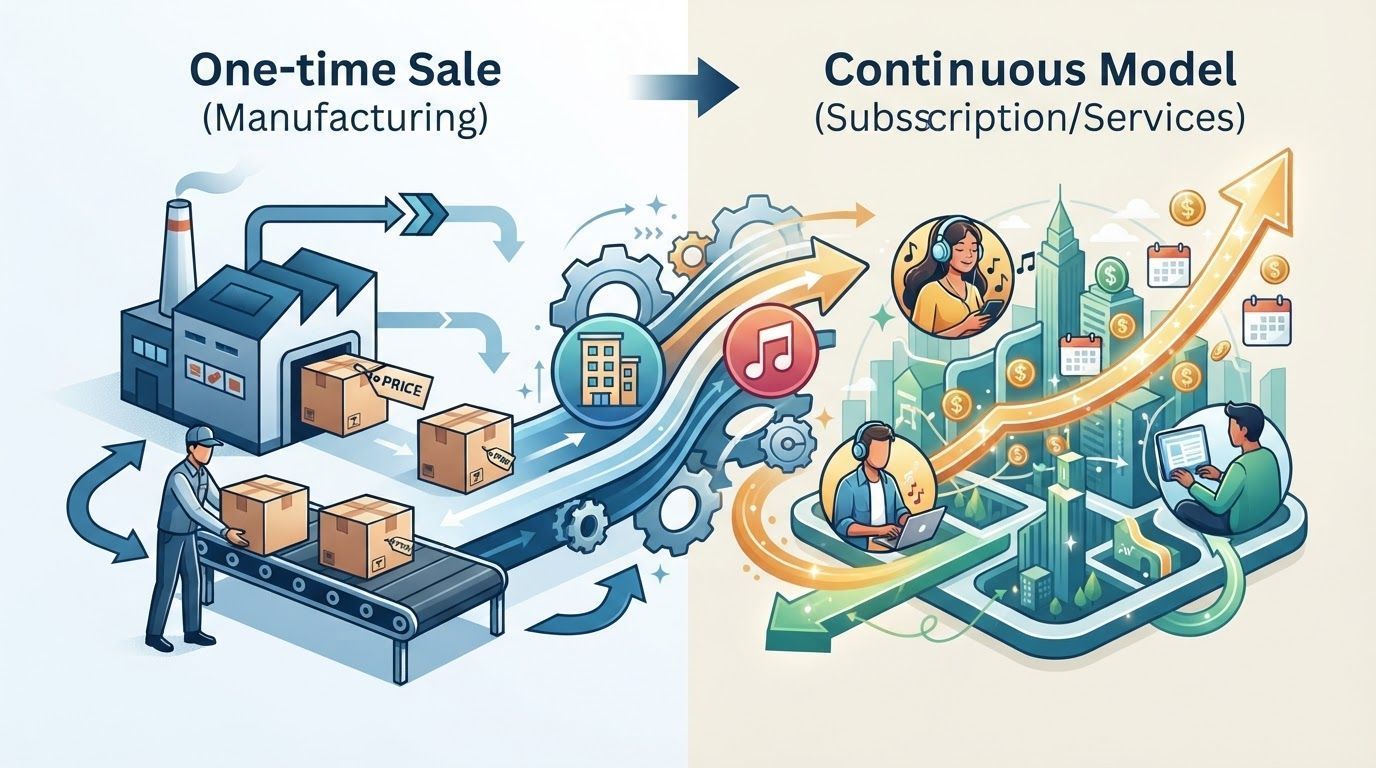
Two companies sell the same kind of system: Company A collects payment once, Company B charges annually and renews year by year. At year-end, A's revenue depends on how many deals it closed this year; B's depends on how many customers chose to stay. That is the divide between the manufacturing-and-sales model and the recurring model (継続モデル): the first hands over value once, the second lets customers use something regularly and keeps charging them.
People often equate recurring revenue with "monthly auto-billing," but billing is only the outcome. What actually changes is how predictable revenue is—and how long the relationship between company and customer lasts.
Two axes of the business model: product strength and how you get paid
Business models are often explained with a diagram. The horizontal axis is the source of value: whether the product or service itself is attractive. The vertical axis is how profit is captured: how the money comes back.
On the horizontal axis, the recurring model and the manufacturing-and-sales model are not fundamentally different. If the product isn't good, neither model sells. The real divide is vertical. The manufacturing-and-sales model is "sell it and move on": money and goods change hands, the transaction ends, and the relationship largely ends with it. The recurring model brings in the idea of "recurring"—splitting one-time revenue into revenue that keeps arriving.
That difference shows up directly in forecasting. With one-off sales, a good year doesn't guarantee a good next year. With recurring revenue, income continues as long as customers don't cancel, making future cash flow easier to estimate. That is why the speaker sees this as one business-model shape many non-manufacturing companies might aim for. Its reach is broad: flat-rate billing, subscriptions, franchising, even patent licensing—consulting, software, chain stores, and more.
The apartment example: why stable cash flow is worth paying for
Rental housing makes this concrete.
A landlord first spends tens of millions to hundreds of millions of yen on land and a building. Personal funds usually aren't enough, so the landlord borrows from a bank and repays a fixed amount every month under a multi-decade plan. For the bank, one key question is whether the building can keep producing stable rent. So the landlord must sign leases with tenants and collect monthly rent. Conversely, if a property can't be expected to generate stable monthly rent, the bank may doubt that the loan will be repaid and refuse financing.
Put the same need for housing back into a "one deal at a time" logic and the picture changes completely. A tenant would move every day like a hotel guest, with nowhere to keep belongings, meals eaten out, and a new place to find daily. The provider would also have to find new guests every day; on a day with no occupant, there is no income, and the monthly loan payment immediately becomes a problem.
So recurring revenue delivers more than booked income. It creates stable expectations for all three parties: the tenant can stay with peace of mind, the landlord can repay monthly, and the bank can collect on schedule. That is why "predictability" is itself a form of value.
Combinability: intangible businesses fit recurring revenue naturally
Another feature of the recurring model is that it combines easily with businesses in other fields—especially know-how, content, and digital products, where there is no physical form.
Music is a prime example. Listening to music used to require software media—records, cassettes, CDs—and hardware players. Record companies sold physical goods, a textbook manufacturing-and-sales model. From the 2000s, digitization and streaming changed that structure: music as digital content has extremely low copying costs, and distributing it through streaming naturally produced subscription services. Spotify is the representative case, offering both a free, ad-supported tier and paid membership—a freemium model.
Convenience stores are a "retail plus recurring revenue" combination. Retail requires enormous investment in store development, inventory, and people, yet profitability is low. Seven-Eleven Japan, under Seven & i Holdings, leaves store operations to franchisees backed mostly by outside capital; headquarters focuses on raising the chain's brand value, developing products, guiding stores, and providing know-how, and collects royalties from franchisees. It runs about 21,000 stores nationwide while owning only 193. Most of its sales come from franchise revenue, and its profit margin is around 28%—highly unusual for retail.
The logic deserves a closer look: headquarters isn't selling a single item on the shelf. It is selling "the ability for franchisees to keep making money." As long as stores keep operating, headquarters' revenue keeps arriving. The billing mechanism is tied to the partner's business cycle.
Renewal is an outcome, not a right
But recurring revenue has an essential premise: the product or service must be attractive enough, or customers will not keep using it.
The convenience-store industry offers a counterexample. Brands such as AM/PM and Circle K Sunkus once existed, but they could not hold out in competition; after mergers with larger chains, they disappeared from the Japanese market. The brands did not vanish because "they stopped charging franchise fees." They vanished because the franchise system could not keep giving stores and consumers enough reasons to choose them.
This shows that recurring revenue does not guarantee "recurring." What it does is turn "win once a year" into "be chosen again every month." The cancel button always sits with the customer; the renewal rate is a record of the past, not a promise about the future. To judge a recurring-revenue business, look beyond contract counts and renewal rates and answer a more concrete question: why would the customer come back next month?
Two multipliers, not one billing method
Pulling this together, the essence of the recurring model is a multiplication: attractive products and services × continued use. If either factor approaches zero, the result approaches zero.
Billing methods can be copied. Pricing pages, automatic renewal, membership tiers—anyone can build them. But stable cash flow cannot be conjured from nothing; it comes from a product that keeps being chosen. For an operator, the real question may not be "can we switch to subscriptions?" but "what do we offer that is worth a customer keeping for a long time?"