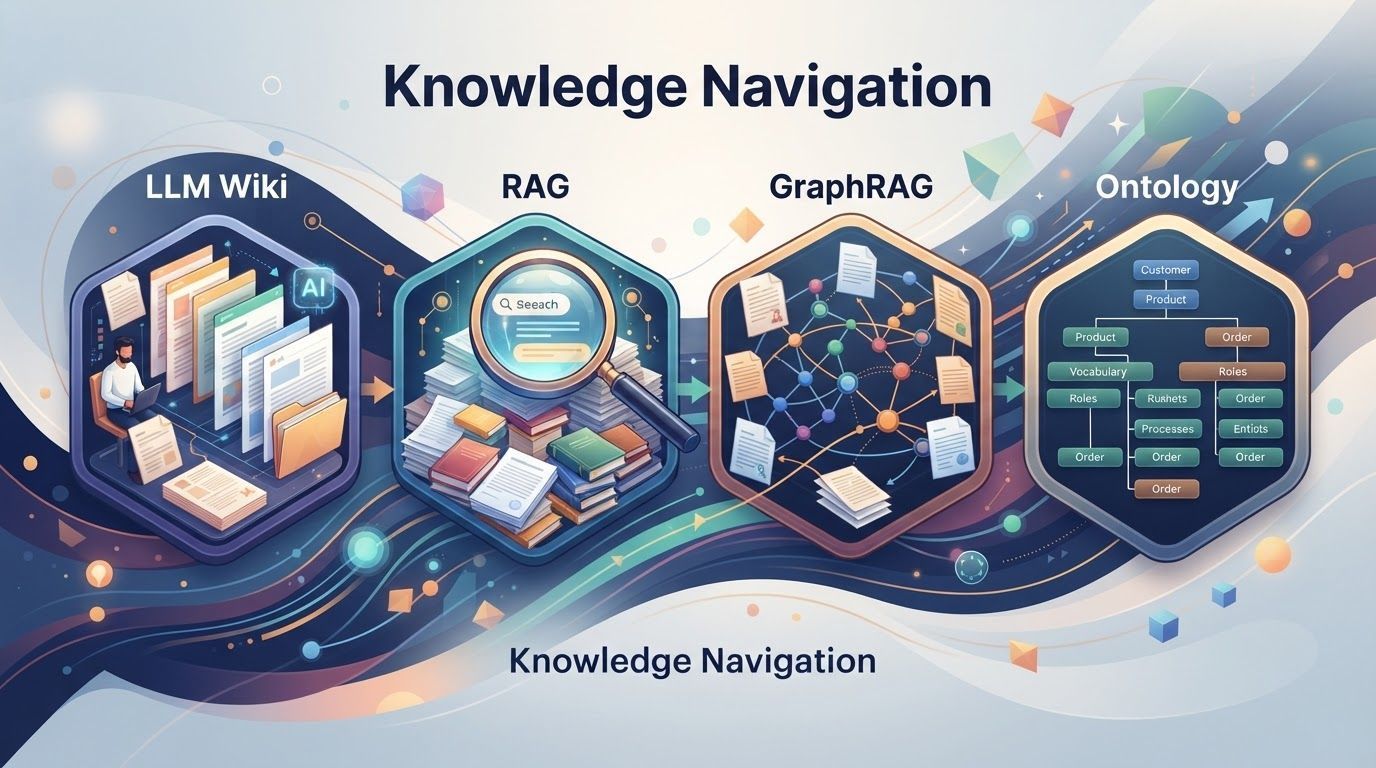
LLM Wiki organizes personal notes, RAG answers from enterprise documents, GraphRAG traces relationships across documents, and ontology unifies business semantics. This article compares how each works, where it breaks down, and how to combine them—and why their “graphs” differ.
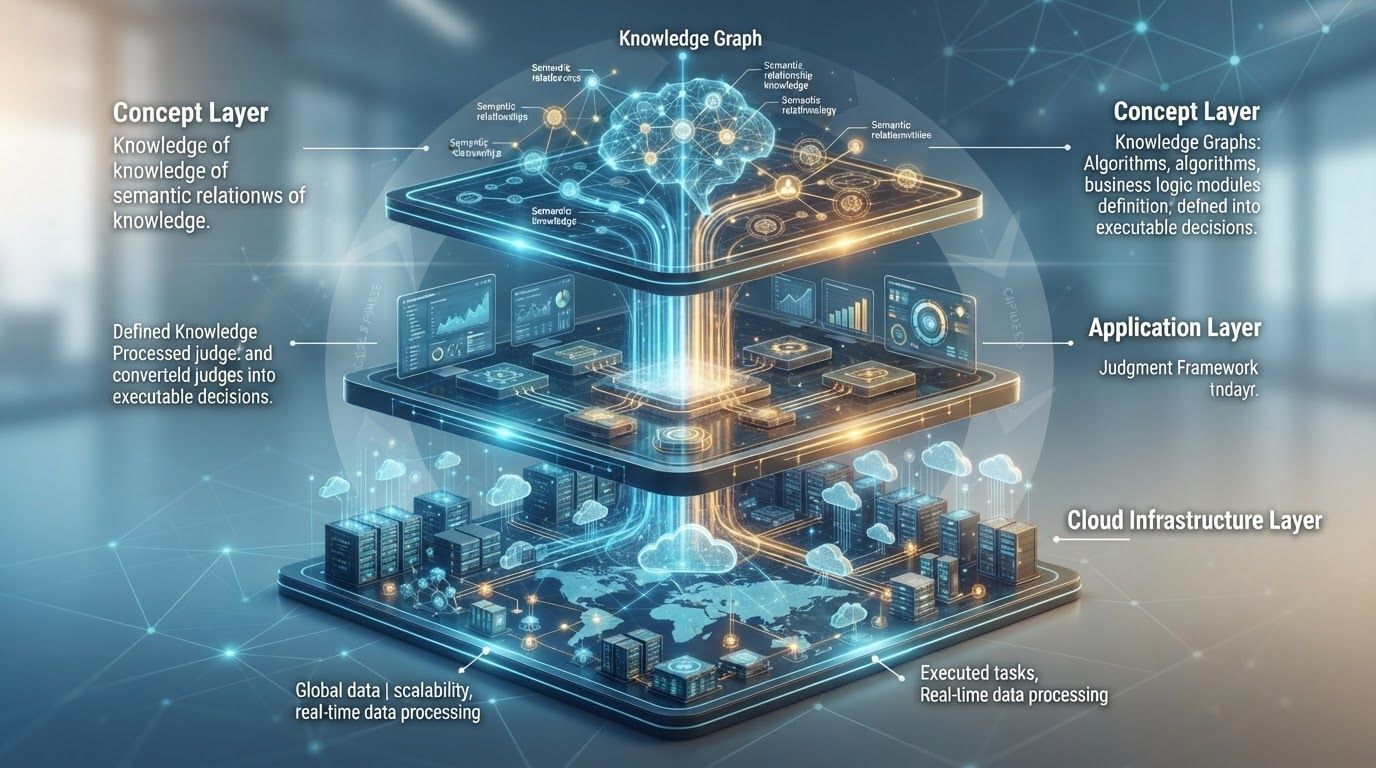
Most enterprise AI proposals stop at “you need a knowledge graph.” This article breaks the problem into three layers: the concept layer that defines what knowledge looks like, the application layer that extracts business logic and makes it judgeable, and the cloud infrastructure layer that lets judgment actually execute. It also covers a judgment framework built on five cycles and six capabilities, a modernization approach that wraps legacy systems in MCP-accessible services, and why intelligence without execution is worthless.
Ontology, knowledge graphs, knowledge bases, and data middle platforms mostly predate LLMs, yet they are back in the spotlight. Drawing on a knowledge graph he built himself, the author explains how the four relate and what LLMs actually changed in ingestion, querying, traceability, and agent execution.
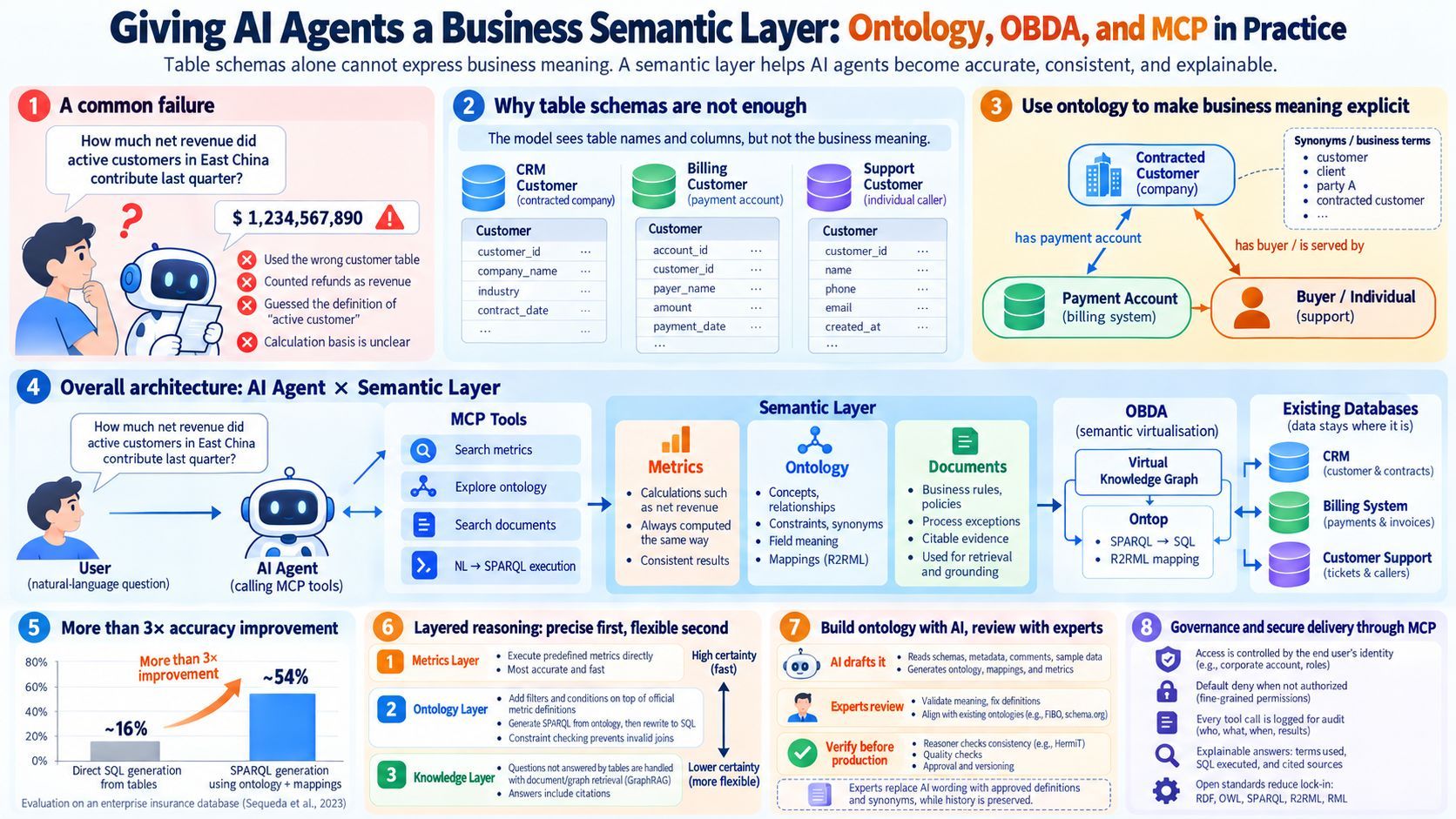
Putting a table schema in the prompt does not teach an AI agent what the business means, so it can still return a number that looks professional but is wrong. Drawing on an insurance-industry benchmark where GPT-4's execution accuracy rose from about 16% to about 54%, this article explains the semantic layer built from metrics, an ontology, and documents; how OBDA maps the ontology onto existing data; and how layered resolution balances determinism with flexibility. It also covers AI-drafted, expert-approved ontologies, MCP delivery, identity-aware governance, and five practical recommendations.
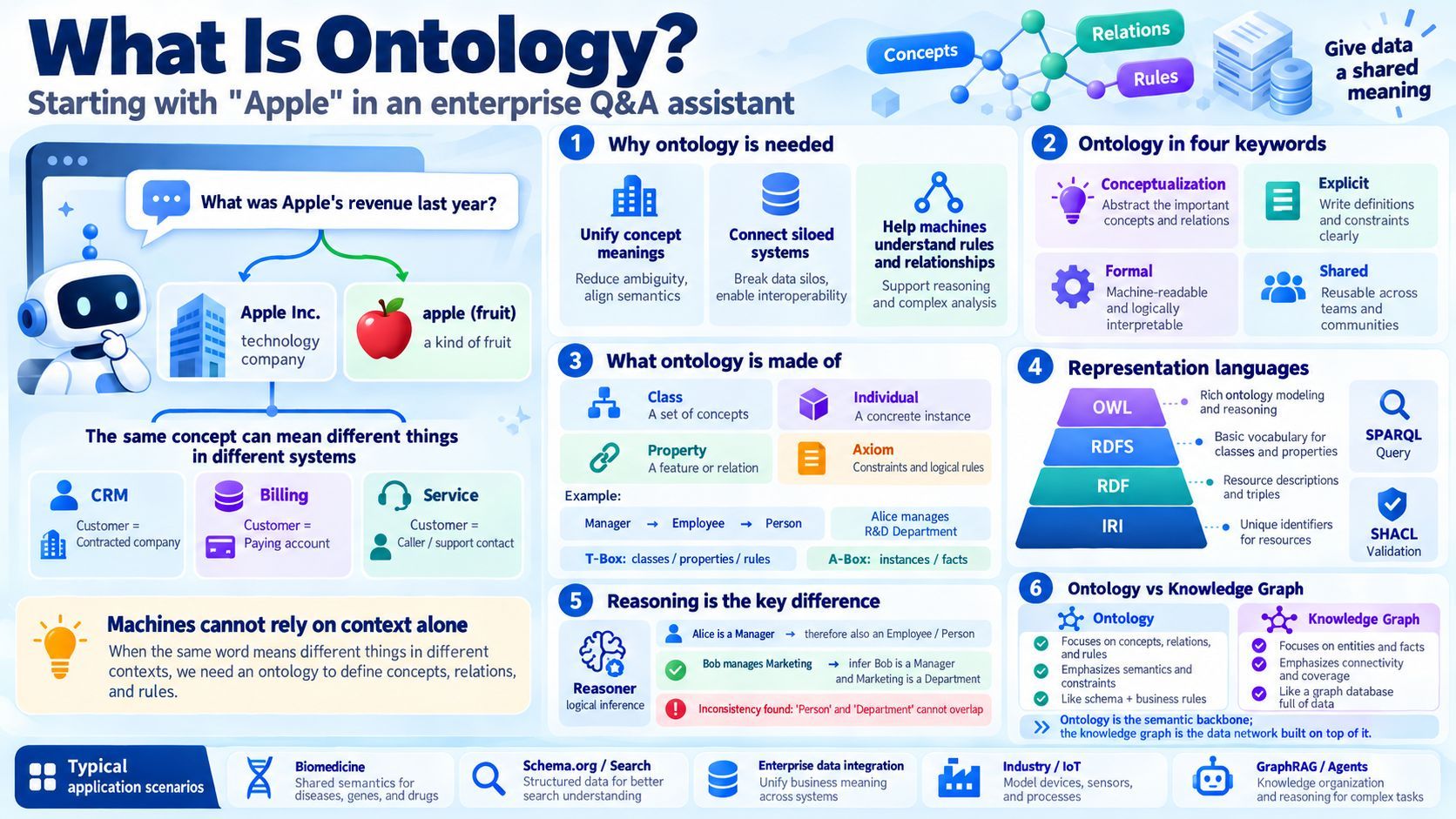
A machine cannot tell that "Apple" means a company rather than a fruit, or that three tables all named Customer mean different things, without an explicit semantic model: an ontology. This article traces the idea from philosophy to Gruber's and Studer's definitions, breaks down classes, individuals, properties, and axioms, and covers RDF, RDFS, OWL, and reasoners. It surveys real uses in biomedicine, Schema.org, enterprise data integration, industry and IoT, and the LLM era, then explains how ontology differs from a knowledge graph and how to start building one.