A Mac teleprompter built with Vibe Coding: a local AI model advances the lines automatically, so you don't scroll by hand while talking. Processing stays on the device and footage needn't go to the cloud, though it only runs on Apple silicon Macs. Beauty filters complete the recording workflow, and the code is open source to download and modify.
A month into a new job, the author hits the same wall he left behind: plenty of drive, no outlet for it. He traces the problem to a culture where talk outweighs action—endless arguments, concepts outnumbering shipped products. Drawing on his experience with Japanese clients, he argues for fixing the inside first: daily reporting, joint planning, and solid work before going out to knock on doors. He then pushes further: in the AI era software products are losing value, and the edge moves to cloud partnerships, cross-selling, and the ability to read people, adjust their state, and inspire them through narrative.
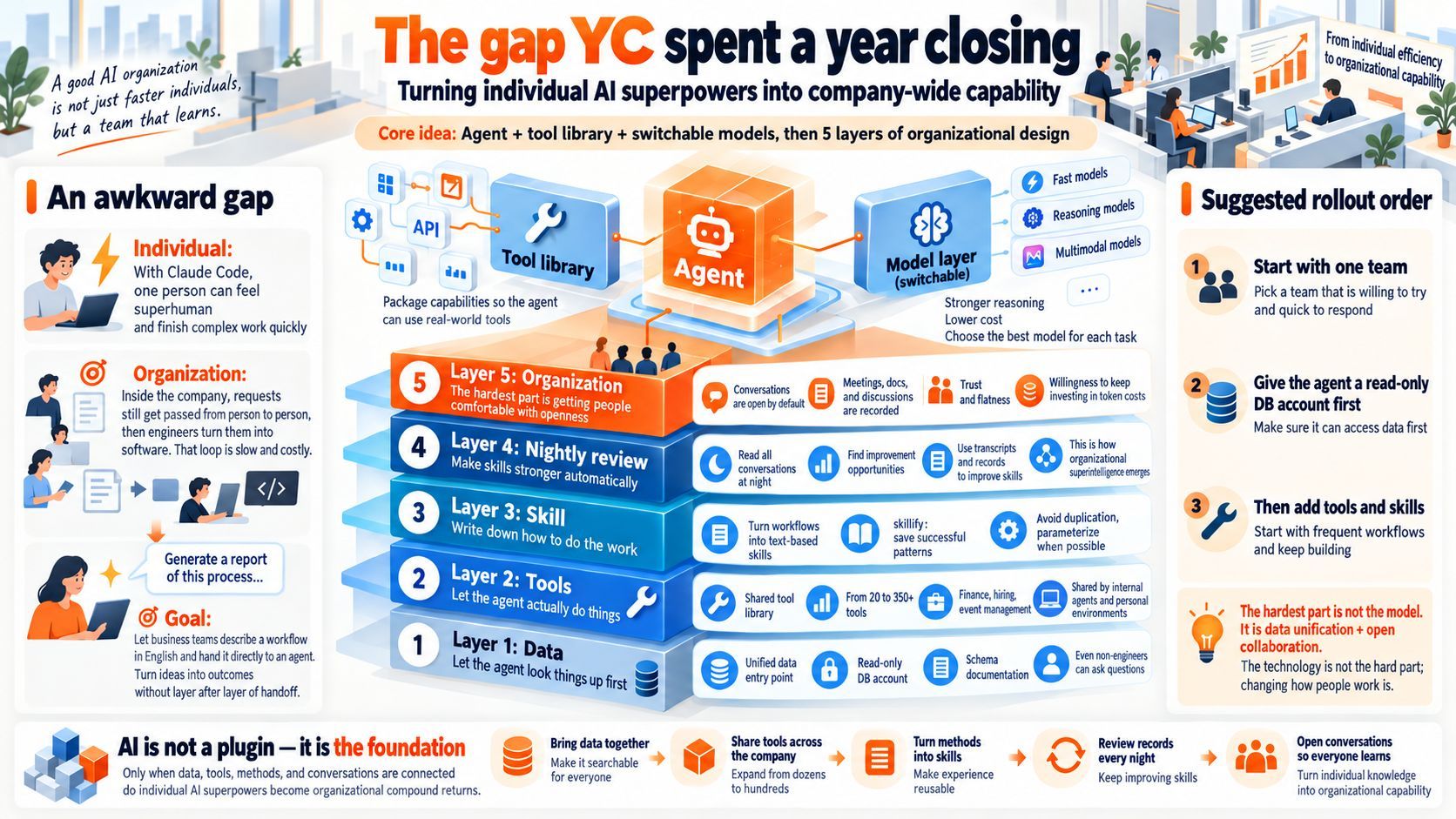
Individuals use AI powerfully, yet companies barely change. YC spent a year building a five-layer system: unified data, shared tools, skills that capture how work is done, a nightly review that improves those skills, and conversations made public by default. Pete explains the structure, the two hardest layers, and where to start.
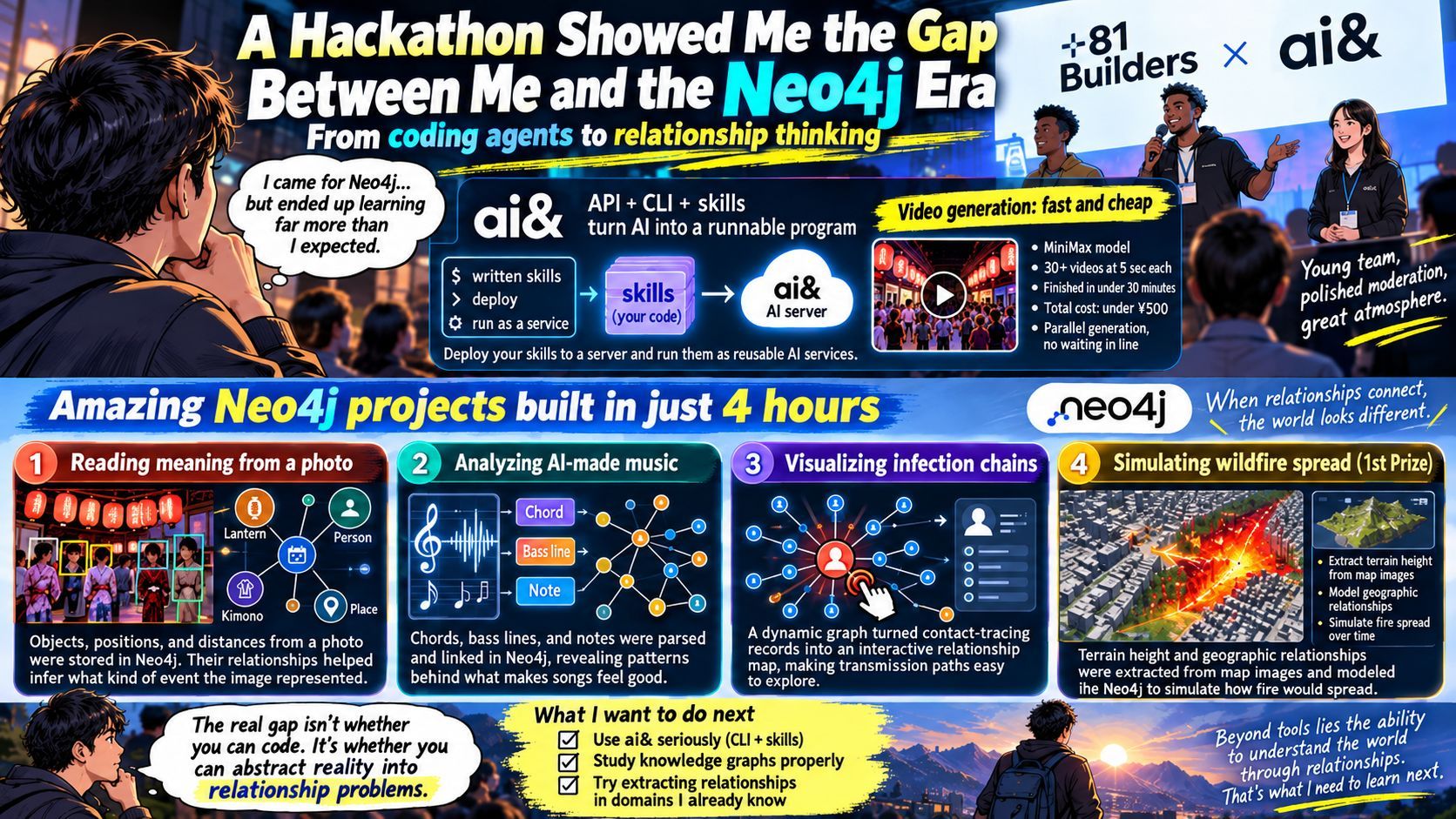
I joined a hackathon hosted by +81 Builders , where ai& showed how its CLI and skills turn an AI service into a deployable server, and MiniMax video generation proved fast and inexpensive. The bigger shock was what participants built with Neo4j in four hours: relationship analysis of photos, music analysis, a dynamic contact-tracing graph, and a fire-spread simulation. The experience made me realize that coding-agent fluency is no longer enough, and that I need to learn knowledge graphs.
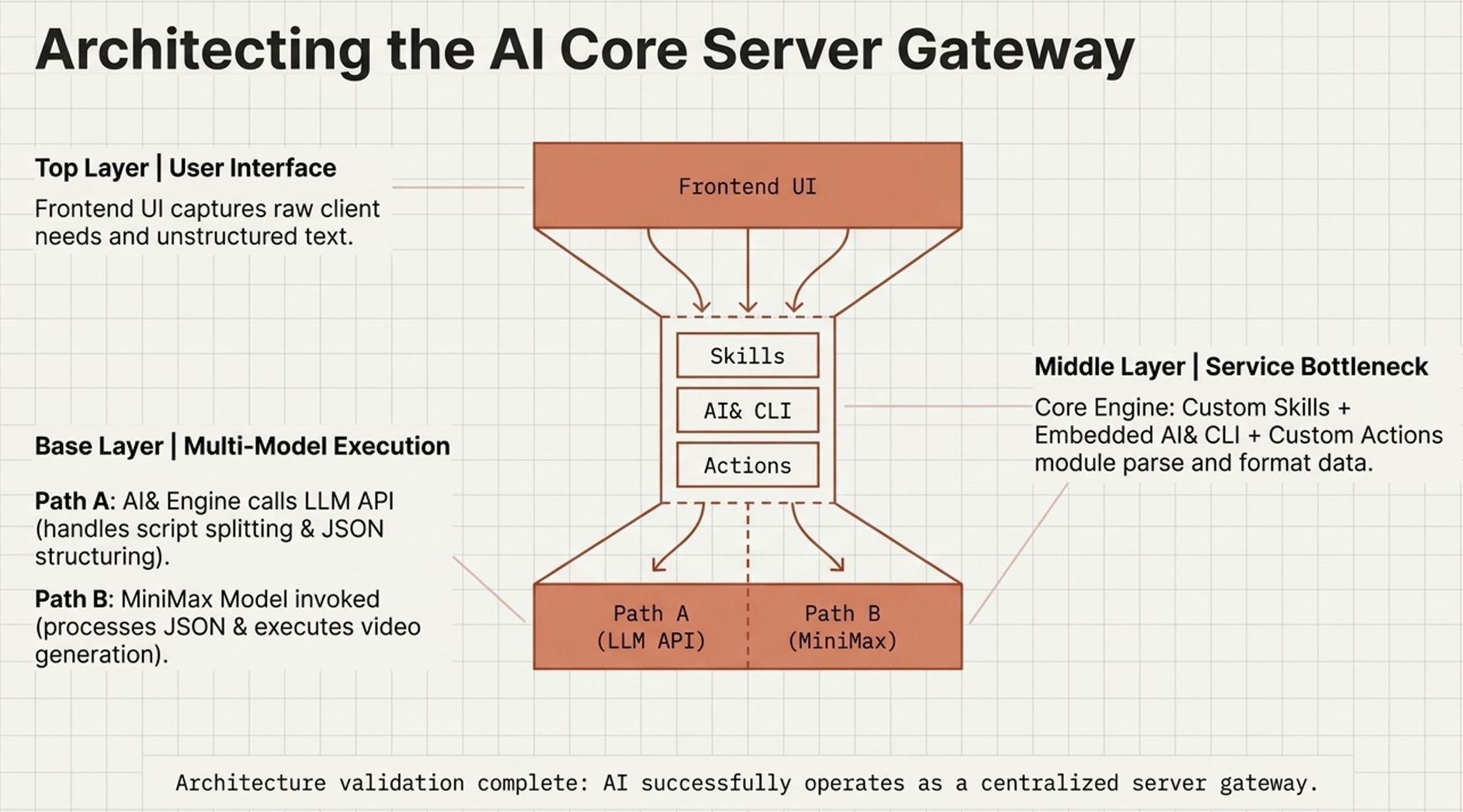
At a hackathon I built a tool that turns a story or blog post into video, validating three layers. The first automatically splits a story into sections, generates prompts, characters, and voiceover, then produces video section by section. The second wraps the AI& CLI in a service layer, using skills to drive the AI LLM API so non-programmers can use it. The third writes the voiceover first and uses it as a reference for MiniMax to generate visuals—a sound-driven approach. All three validations succeeded.
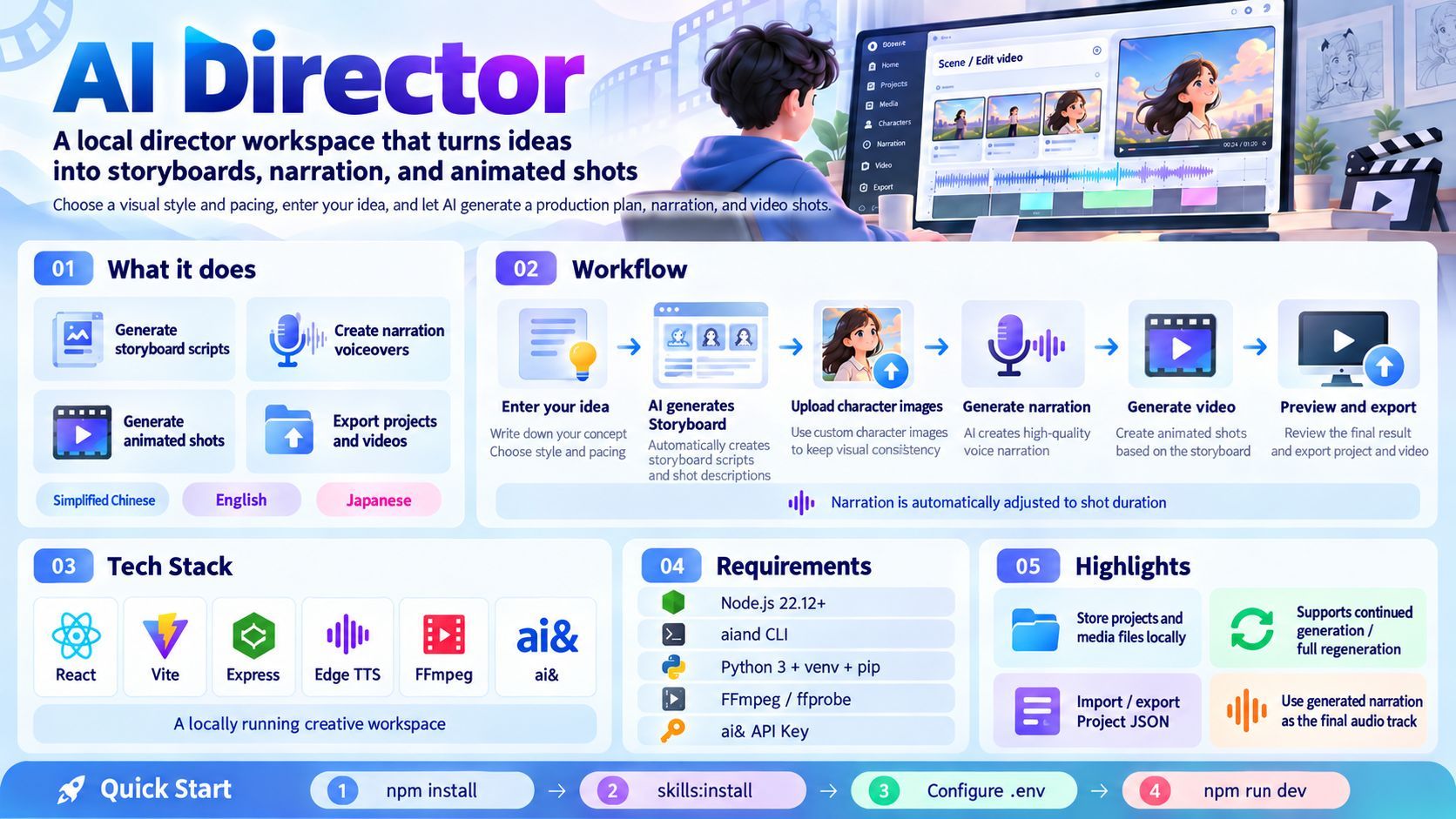
AI Director is a local director's workspace that breaks an idea into a storyboard, characters, voiceovers, and shots. It constrains AI output with validated project JSON, fits Edge TTS narration to each shot's duration, and generates video through ai&'s MiniMax H3. This article walks through the production flow, timeline handling, the boundaries of paid tasks, the local-first data design, and the engineering choice to load and validate the Skill explicitly.
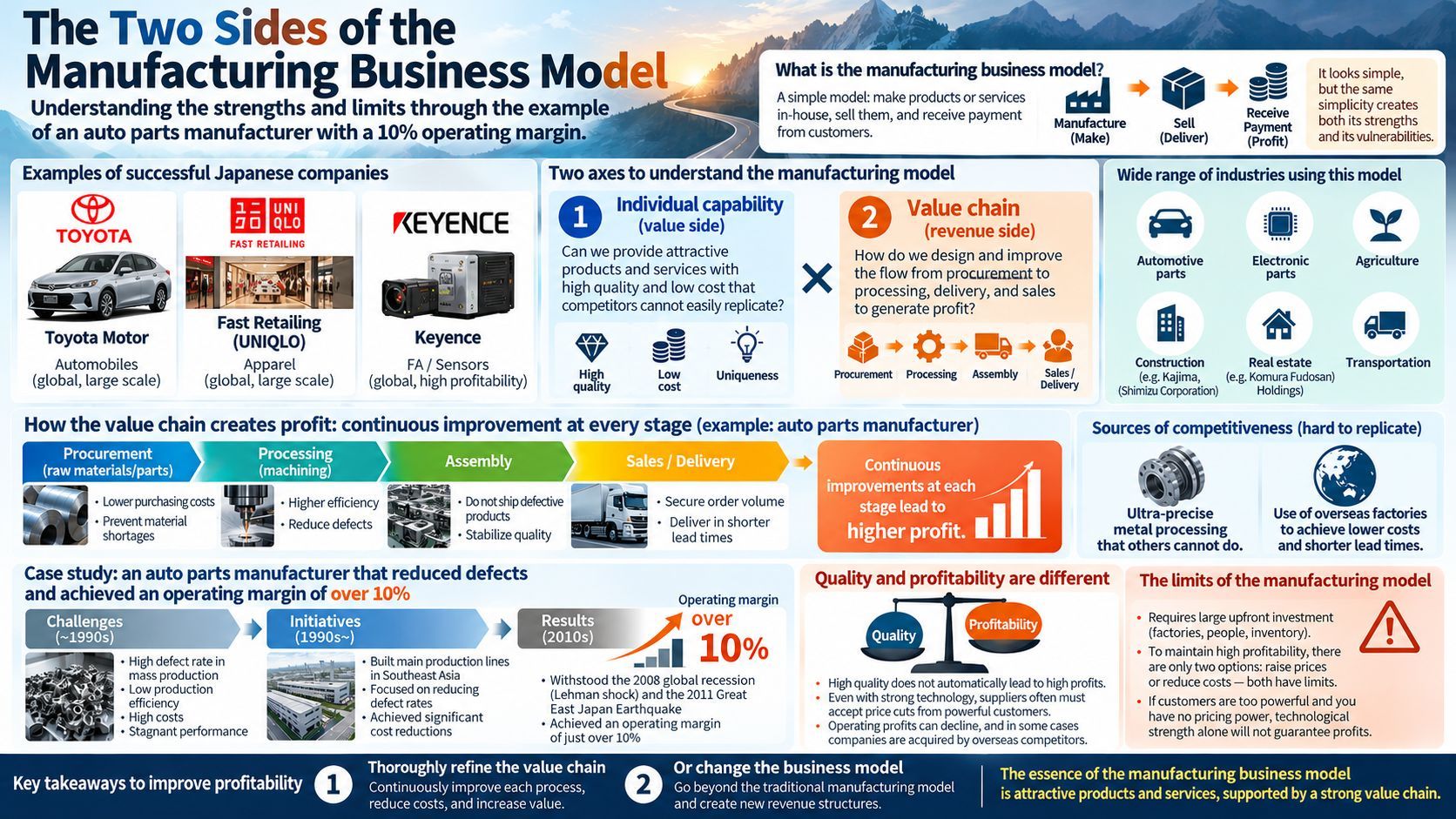
The make-and-sell model looks simple: a company manufactures and sells its own products and is paid by customers. Yet its strengths and its fragility come from the same place. Two axes matter: standalone strength—high quality, low cost, and things rivals cannot do—and the way revenue is earned across the value chain of procurement, processing, and delivery. One ultra-precision parts maker stagnated on mass-production defects, moved its main line to Southeast Asia in the 1990s, and improved defects so thoroughly that it held an operating margin above 10 percent through the 2008 recession and the 2011 earthquake. But quality and profit margin are different things: a supplier that cannot refuse price-cut demands does not recover, and was acquired. The only ways out are to overhaul the value chain or change the model.
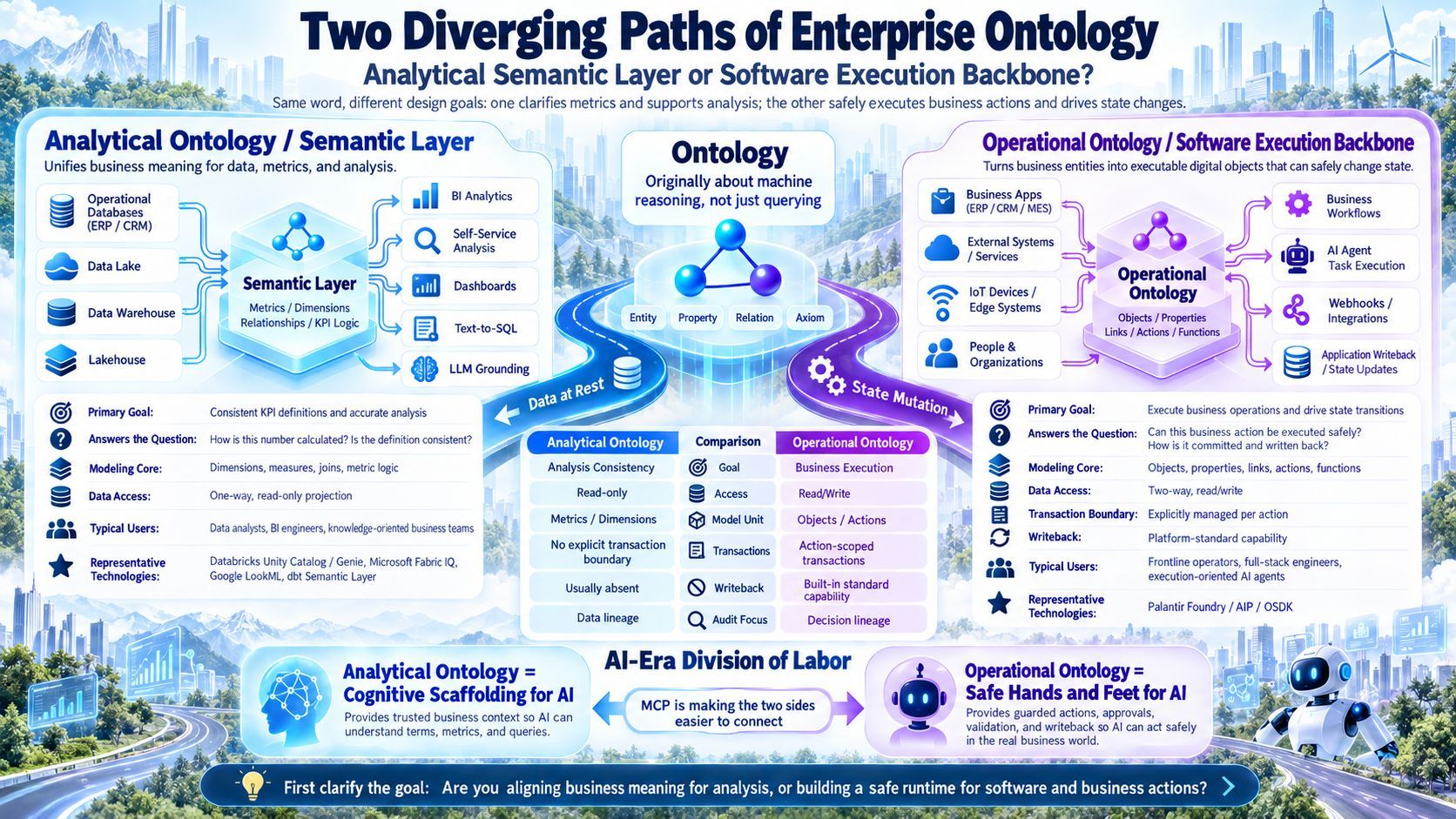
Enterprise ontology has split into two currents. The analytical semantic layer unifies metric definitions and supports BI, Text-to-SQL, and LLM grounding in a read-only way; the operational ontology fuses state-change transactions, precondition validation, write-back to external systems, and type-safe OSDK code generation into a runtime for business applications. The offerings from Databricks, Microsoft, and Google Cloud are essentially extensions of the former, while Palantir represents the latter, implementing enterprise-scale CQRS and decision lineage. This article compares their structures, their division of labor in the age of AI agents, and a selection matrix for enterprise architecture.
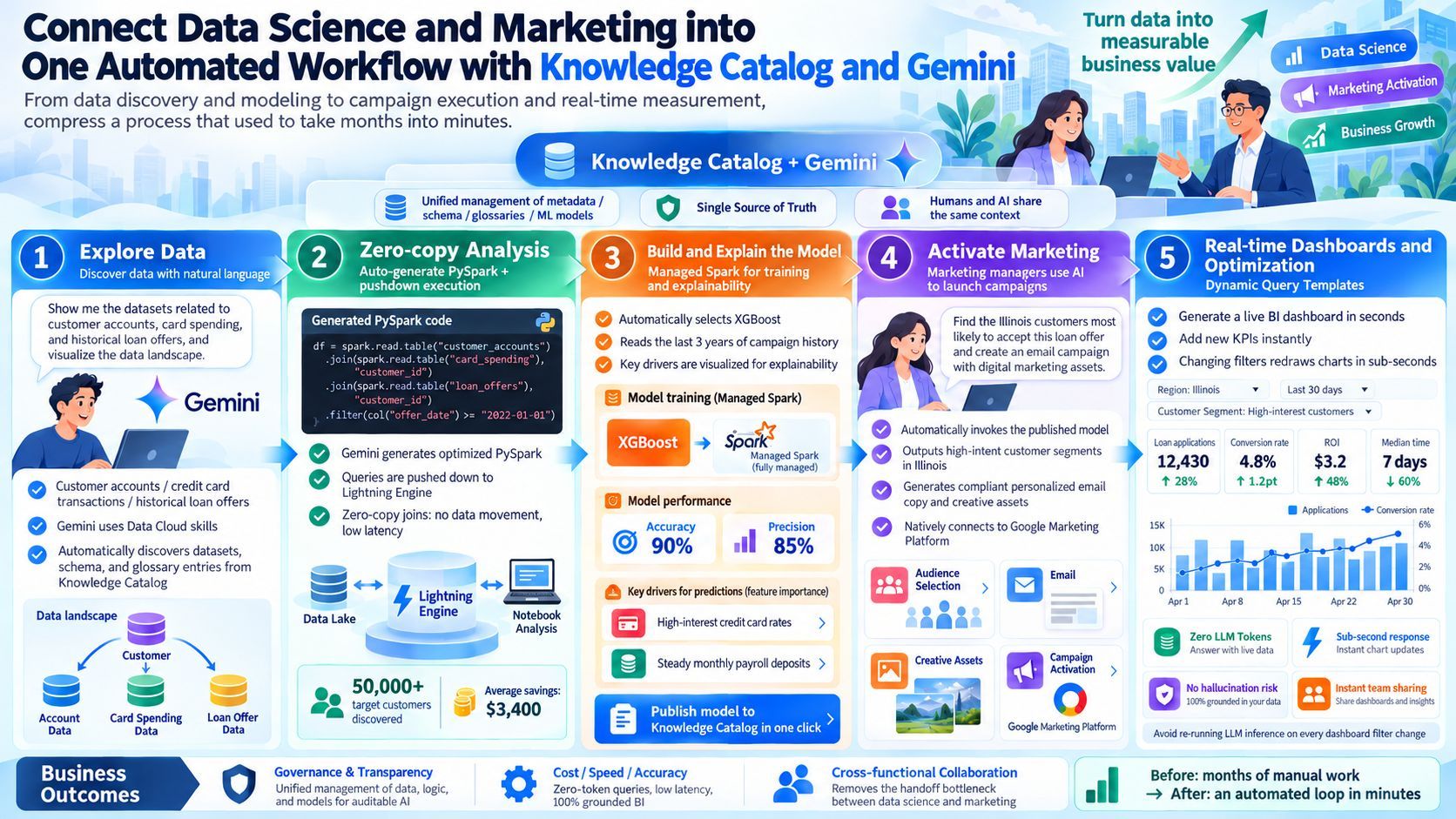
Using a retail bank loan-switch example, this article shows how Knowledge Catalog and Gemini connect data science with marketing: natural-language data exploration, auto-generated PySpark with zero-copy joins on Lightning Engine, an XGBoost model (90% accuracy, 85% precision), one-click publishing to the catalog, and zero-token BI analysis that compresses months of work into minutes.
Why did "business model" become a keyword? This article traces the term's earliest uses in the Japanese business press: the 1995 coverage of Dell and its direct sales plus build-to-order model, the 1997 feature on how PlayStation rejected Nintendo's business model, and later talk of an existing model no longer working as Japan's chip industry came under pressure. It then turns to Toyota — the two pillars of Just-in-Time and jidoka, the flaws of push production, the pull system inspired by American supermarkets, and why Ford-style mass production was overkill in Japan. It closes with Masayoshi Son's time machine management and the idea that there is no single right angle on a business model.
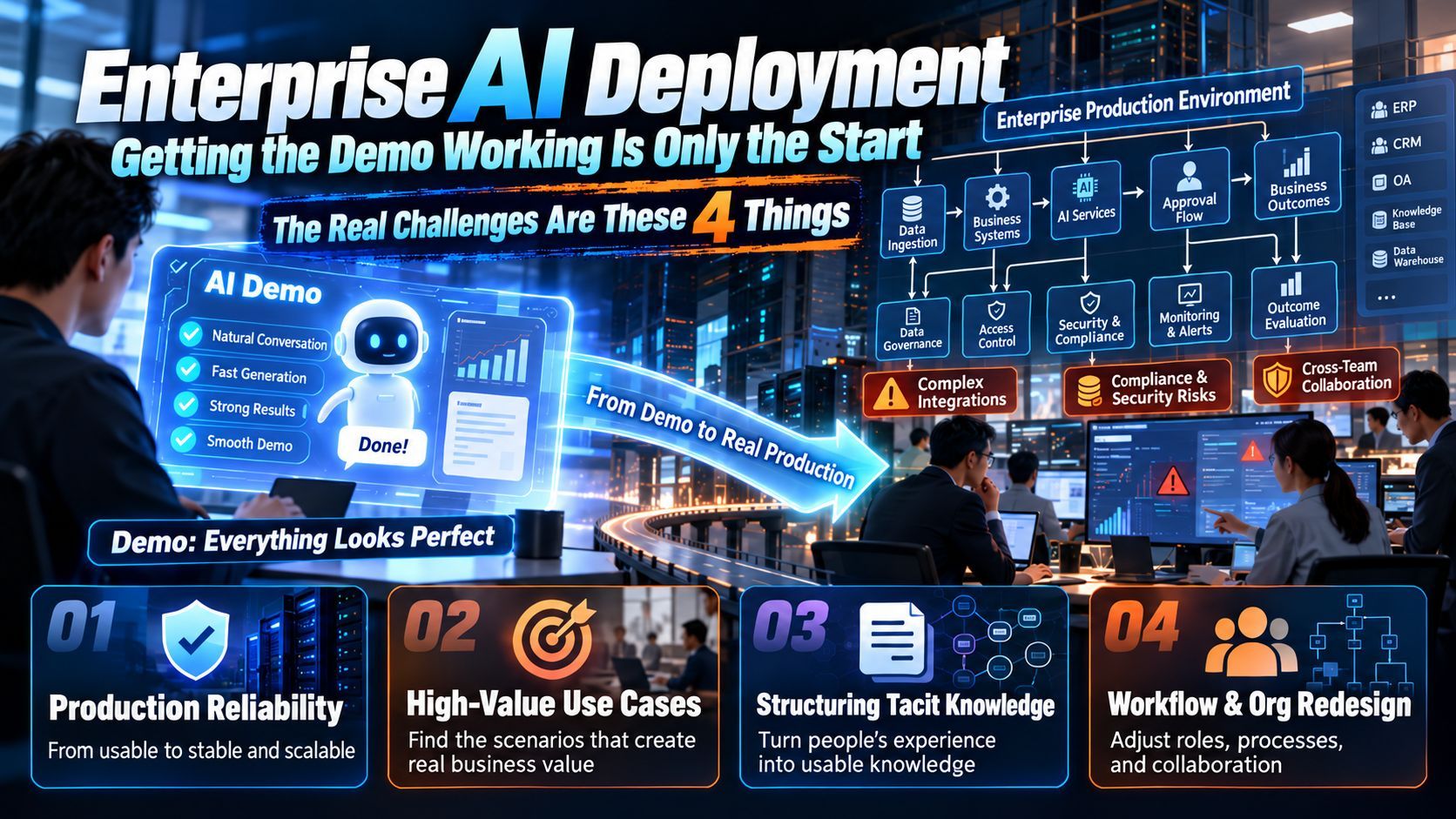
Using the Tencent Research Institute's FDE report as a lens, this article lays out four problems that recur in enterprise AI adoption: mistaking a working demo for a shippable product, building an AI application without choosing a high-value scenario, assuming AI can do what employees already do well, and confusing individual productivity with organizational productivity. Drawing on AI customer service and ERP examples, it explains the gap between demo and production and why tacit knowledge must be turned into usable context, then offers three fixes: don't measure the adoption cycle by demo speed, organize small teams where business and technology share accountability, and have senior leadership personally drive process, responsibility, and assessment changes.
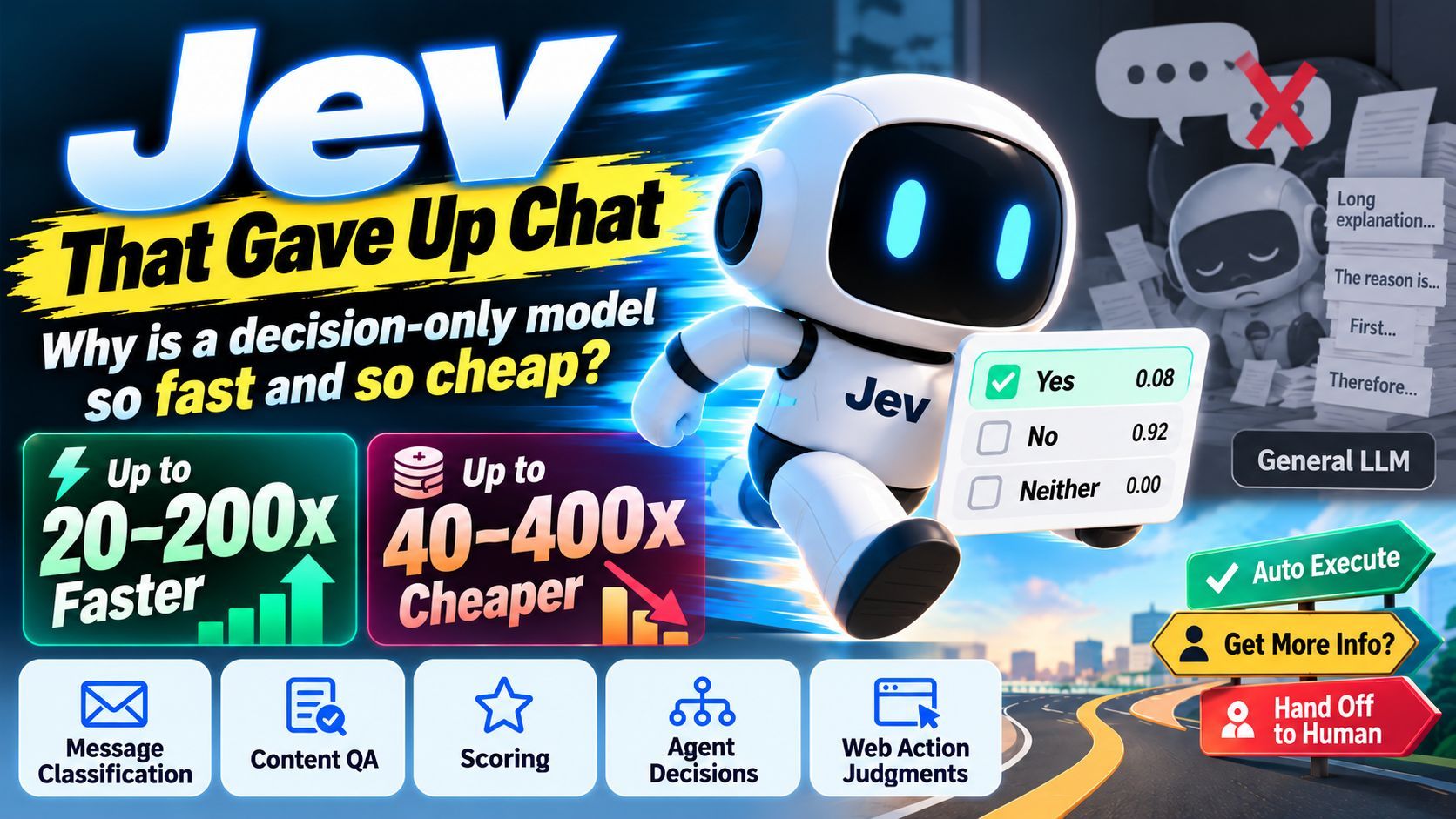
TypeSafe AI's Jev does not write; it returns decisions and their probabilities. In official tests it is up to about 193.6 times faster than a general-purpose LLM and about 444.6 times cheaper, at $0.042 per million input tokens with free output. Called with a state and a question, it answers as Noul, Choice, or Score, and is trained with RLCD so its calibrated probabilities can drive automatic routing—a division of labor among judging, generating, and executing.